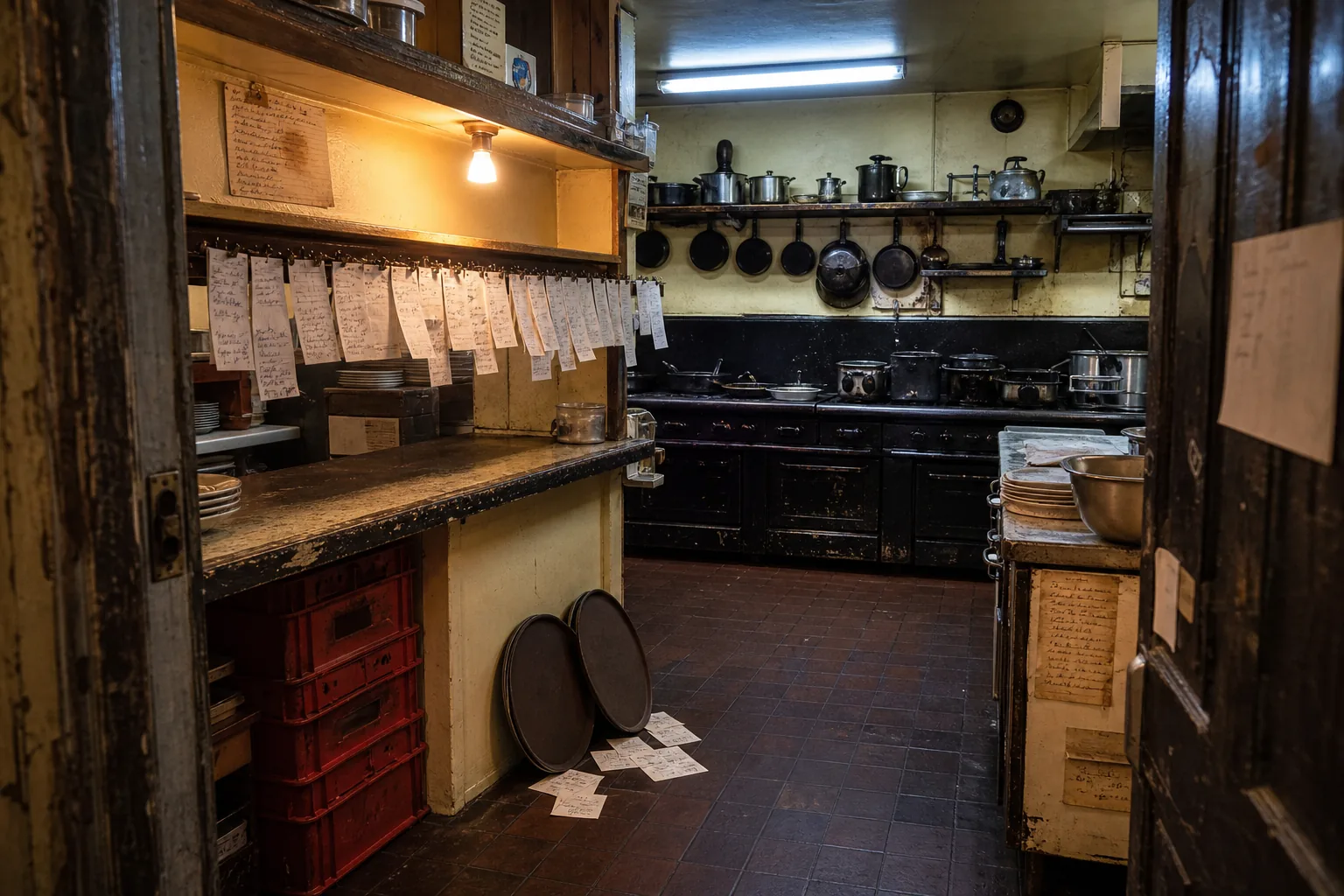
A close-up can teach a fold, a texture, or the point where onions have actually softened. It can also hide quantities, elapsed time, edits, and the batch that failed before the camera started rolling.
There is a kind of cooking video that makes a person feel unusually capable.
The knife work is clean. The pan behaves.
The onions go from stern little cubes to softness in a few agreeable cuts.
Then comes the final spoonful, glossy under good light, and the caption says dinner. It is reasonable to think you have watched the recipe.
You have watched something real.
You have not necessarily watched the information that makes it repeatable.
A video can show a motion in a way prose cannot. Whether a fold is a lift or a knead. Whether an emulsion is glossy.
Whether the vegetables are still intact or have gone properly soft.
That is not a small gift.
It is the difference between “until it looks right” and seeing the thing it is meant to look like.
But a recipe is not only a sequence of visible gestures. It is a claim about quantities, equipment, time, yield, and an endpoint under stated conditions.
The two forms overlap so pleasantly that they get mistaken for each other.
A close-up records a cue
Video is excellent at the facts that arrive through the eyes. It can show browning. The way a sauce coats a spoon.
The speed of a fold, the moment a cook changes tools. It can hand you a bodily cue you have never seen before.
That is evidence of a narrow kind.
The creator performed that motion, in that kitchen, in that recording.
It cannot tell you the weight of what sat just outside the frame. Or the pan material.
Or the actual heat, the room for error, the yield after trimming.
It cannot say whether a stated duration means time at the stove, time after the cut, or time after the editor removed the waiting.
A short post can make a long process look effortless. Compression is one of its jobs.
This isn’t deception.
It is the form doing what it is good at.
The trouble starts when an attractive demonstration is asked to be a production specification with a pleasant soundtrack.
What the frame leaves out
Watch for the pan.
A final overhead shot shows a handsome square.
It cannot say whether the pan had the geometry the recipe assumes, or whether another one was tried before the camera rolled.
Depth changes how a batter bakes, and a shot from above has no opinion about depth.
Watch for the yield.
“Makes 12 cookies” means something only alongside a scoop size and a counting rule.
“Serves four” is an editorial judgment until somebody says how much four people are getting.
And watch for the rehearsal.
Food styling is not cooking evidence. It is evidence that food was styled. Lighting, framing, editing and retakes can make a plated result persuasive.
They cannot establish ordinary consistency, or freshness, or how many attempts reached the plate. A very flattering bowl is under no obligation to disclose its rehearsal schedule.
A final image does not report the test
Testing makes a modest claim, and it is stronger for being modest.
A tested recipe gives the yield, a sequence that worked, an endpoint anyone can observe, and the conditions somebody observed it under.
A sauce coating a spoon tells you whether to stop.
“Perfect” does not travel nearly as well.
Repeatability is not machinery. It means separate attempts, under described conditions, land close enough for the purpose stated.
That purpose includes the equipment.
A stand-mixer formula can be workable at bakery scale and hopeless in a small bowl.
A pressure-cooker dish can be feasible on a weeknight and not feasible in a pot on the same schedule.
None of that is visible in a final image.
Time has its own evasions. A two-hour bread recipe might want fifteen minutes of attention and a long wait.
A thirty-minute dinner might want all thirty at the stove.
The finished plate makes them look equally punctual.
Usually the video and the written method improve each other. The video gives the bodily cue. The writing gives the conditions, the range, the correction trail.
And when the written method carries a version history, a substitution, a reader-found ambiguity, it offers something a polished first take cannot.
Evidence that the instruction was allowed to become more accurate.
Pause it before you trust it
Before planning anything large from a video, stop it once.
Write down what you would need.
Quantities, pan size, equipment, heat, active time, waiting time, yield, and the endpoint you are cooking toward.
Then go looking for the written source.
Every blank you cannot fill isn’t a failure of attention. It is a question the recording can’t answer by looking prettier.
The current answer may be in a caption, a linked page, a comment, an updated post. Recipe work drifts.
Brands vanish, package sizes change, links rot, ovens age, and readers keep finding the step that was obvious only to the person who wrote it.
None of that reaches anyone through a beautiful shot of the finished dish. So enjoy the video. It is doing real work, and doing it well.
Just don’t ask it to promise dinner. Ask the writing for that.
Questions this raises
Can a cooking video be enough to follow a recipe?
A cooking video can be enough to demonstrate a narrow action, such as a fold, a knife motion, a texture, or a tool position. It is not automatically a complete recipe specification. A reliable method also states quantities, yield, equipment, timing, sensory endpoints, and relevant storage or correction notes in a persistent written record.
What information does a short cooking video usually leave out?
Short cooking video can compress preparation and make a complex process appear effortless. It may leave weight, pan dimensions, heat level, passive time, total elapsed time, yield, ingredient preparation state, and failed attempts unshown. A final plated image also cannot establish ordinary consistency, portion size, freshness, service speed, or nutritional content.
What can a cooking video show better than written instructions?
Cooking video is especially useful for visible and embodied cues: the speed and direction of a fold, the texture of a dough, the degree of browning, the consistency of an emulsion, and tool handling. Those observations complement a written method. They do not replace the quantities, equipment, timing, yield, and conditions needed to judge whether the demonstrated result can be repeated elsewhere.
How can someone check whether a video recipe has enough detail?
A practical check is to pause the video and list the ingredient weights or quantities, pan size, heat, active time, passive time, total elapsed time, yield, and sensory endpoint. Each blank needs a written source before scaling or planning a meal. A caption, linked page, comment, or later post can contain an updated ingredient list or correction.
Why does pan size matter when a recipe is scaled down?
Pan area affects batter depth and therefore cooking behaviour. A 9 × 9-inch pan has 81 square inches of area, and a half batch of the stated example targets roughly 40.5 square inches rather than merely any smaller pan. That calculation guides pan selection, but material, depth, and oven behaviour still affect the outcome.
Why do tested baking recipes use weight and baker's percentage?
Mass reduces some measurement ambiguity, and baker's percentage fixes flour at 100 percent while expressing other ingredients relative to flour weight. A documented French-bread formula using 65 percent water, 2 percent salt, and 1.25 percent yeast preserves those relationships when batch size changes. It does not guarantee identical flour, fermentation, or oven behaviour.
Why is half an egg not a complete recipe instruction?
A standard large egg weighs about 50 g out of shell, including approximately 14 g yolk and 35 g white. A half-batch becomes operationally clearer when beaten egg is weighed rather than divided by sight. The measurement choice does not make every home recipe need grams; it shows why a precise written specification can solve a scaling problem that video may conceal.
Does a beautiful final shot prove that a recipe was tested?
No. Styling, editing, lighting, selective framing, and retakes shape food images and video. A finished dish can show that a creator presented food in a particular way, but it cannot alone prove the quantities, yield, ordinary consistency, feasibility, or number of successful attempts. A tested recipe reports the conditions and results it actually observed.
What does a tested recipe actually prove?
A tested recipe can report a yield, a sequence that worked, a sensory endpoint, and the conditions under which those observations held. Repeatability means that independent attempts under described conditions reach an outcome close enough for the stated purpose. It does not mean a formula is foolproof or that every kitchen, ingredient, and oven behaves identically.
Why should a recipe separate active time from total time?
Active time, passive time, total elapsed time, and advance preparation answer different planning questions. A two-hour bread process can involve 15 minutes of hands-on work and a long fermentation, while a 30-minute dinner can require attention at the stove throughout. A video montage can blur those differences; a tested recipe names them so a cook can plan realistically.
Can a recipe video give safe storage advice?
A recipe video can repeat storage guidance, but the guidance needs an identifiable source and a stated food process. USDA recommends using cooked leftovers within 3 to 4 days in the refrigerator. That general interval does not create a bespoke safety guarantee for every home process, and an attractive leftover is not evidence that it remains safe.
Why do recipe corrections and version history matter?
Ingredient brands disappear, package sizes change, links break, oven assumptions age, and reader reports can expose ambiguity. A digital recipe can be corrected and versioned, preserving what changed and why. Silent rewriting makes testing history difficult to recover, while an updated caption, comment, linked page, or post can give cooks an important correction.
Does an old recipe document prove that the method works today?
No. A 1498 printed edition of De re coquinaria establishes the existence and contents of that edition, and Jefferson's pasta-machine instructions from around 1787 establish a documented historical record. Neither document proves that a modern reconstruction is historically exact or successful in every kitchen. Documentary provenance and present performance are separate claims.