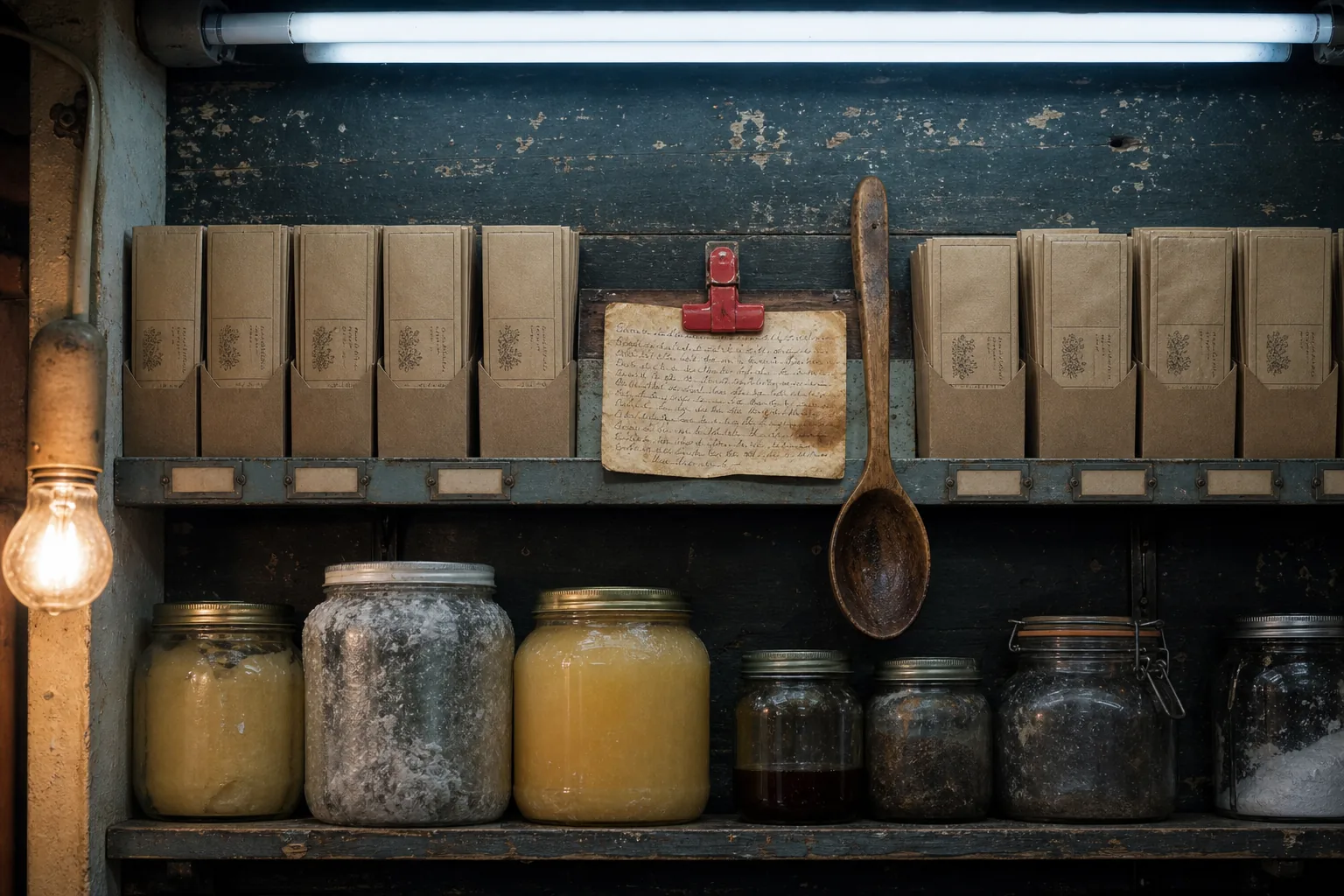
A cookbook can be a very persuasive object.
There is cloth under the jacket.
There is a photograph that makes a bowl of beans look as though it has a small inheritance.
The type is beautiful. There is a page marker, and possibly a stern little ribbon.
None of that tells you whether the recipe in the middle has ever been cooked twice.
This isn’t an insult to the book.
It is a request to let the book be what it is.
A printed recipe can preserve a voice or a record; a tested recipe makes an operational promise.
Those can live together. A recipe can be lyrical and precise.
It can also be eloquent about butter and entirely silent about the pan, the heat, and the moment the sauce is done.
That one may still be worth reading. It is simply not ready to supervise your Tuesday.
Instructions before mood
A usable page starts with a title and a yield.
A formula that says 200 g of flour is giving you a different instruction from one that says a cup.
When somebody has actually tested it, the page can also tell you active time, total time, equipment, ingredients in the order you will use them, and a method broken where the actions change.
That list is not bureaucratic garnish.
Yield tells you what sort of dinner is being promised. Ingredient form tells you whether the onion is whole, chopped, raw or already cooked.
Naming the pan and the heat stops the method from assuming that all vessels are morally interchangeable.
Then comes sequence.
Anything that has to happen in advance belongs where you can see it before it becomes urgent. Soaking. Thawing.
Preheating. Chilling.
An instruction to reserve an ingredient belongs before the ingredient is poured in with the rest.
It is a small kindness, and it stops you developing opinions about punctuation.
Sensory cues do their own work.
“Cook until the onion is translucent and softened” gives you something to look at. “Reduce until the sauce coats a spoon” makes the decision visible.
“Fold until no dry flour remains” tells you when to stop.
A time on its own records an aspiration.
A cue beside the action lets you recover when your pan behaves differently from the author’s.
So the practical check is pleasantly nosy.
Before you commit to dinner, look for the yield, the timing, the equipment, the heat, the ingredients in order, and an endpoint you can see.
Look for storage and reheating if the dish needs them.
If several are missing, make a small batch first.
That isn’t distrust.
It is the courtesy you would extend to a sentence with an unnamed pronoun. Pause until it’s clear who is meant to be doing what.
Testing narrows a claim
A test-kitchen book may tell you its recipes were developed and cooked repeatedly under an editorial process.
That statement matters. It says somebody tried to make the method legible beyond their own hands.
Usually it improves your odds.
It still does not prove that every brand, appliance, altitude, substitution, doubled yield or skill level will behave the same way.
A recipe establishes a result with a particular ingredient form, pan, appliance and batch size.
It cannot quietly annex every other kitchen.
Which is why a good recipe names its tested conditions instead of pretending not to have any.
Then you can see the limits yourself. A different pan changes browning. A prepared sauce brings its own salt.
A smaller batch cooks faster.
An alternative is useful when it says what it changes. Not when it arrives dressed as the same thing.
Testing does not eliminate error either.
Quantities get mistyped. Ingredients vanish between the list and the method. Steps land out of order. Units convert badly.
Captions meet the wrong recipe.
Corrections appear later, because print is not an oath administered under dramatic lighting.
When something fails its own internal logic, compare the ingredient list against the method. Identify the exact edition.
Check whether the publisher has posted corrections.
Describe your particular attempt rather than declaring every copy condemned. That is a more useful kind of skepticism. It is specific enough to cook with.
Some books preserve the rest
A family or community collection may hold a cook’s voice, a household method, sparse measures and a great deal of implied practice.
That does not make it careless.
It may make it intimate.
A narrative-first book can put essays, memoir, travel or photographs first, with the recipes as one part of its argument.
A historical cookbook shows how a writer or a household understood food at a particular moment.
Those are real accomplishments.
A transcription from a hundred years ago is a primary source for its own text, its language, its assumptions about who was in the kitchen.
It’s not a current test, and it was never trying to be.
Your job is not to rank these against a weeknight test-kitchen book as though they were competing for the same parking space.
The question is use.
For a dinner plan, look for directions and a day-to-day structure. For a regional history, look for attribution.
For an author’s aesthetic, a restaurant monograph may tell you far more than a troubleshooting chart, while being much less prepared to say what happens in your oven.
And no cookbook contains a whole cuisine.
Food traditions are made by people, place, migration, season, religion, class and household habit.
A nationally titled book is one author’s perspective.
A community book represents its contributors, not everyone who might claim the dish.
That limit is not a flaw to conceal.
It is the source label.
Old instructions need a different respect
Historical does not mean wrong. Modern does not mean culturally complete. But an old canning direction is evidence of historical practice, not current safety guidance.
The same caution belongs around curing, fermentation, low-acid foods and long storage.
For those, ordinary recipe testing is not enough to invent a rule, and a pleasant story certifies nothing at all.
The same restraint helps with photographs.
A food image shows one serving suggestion, shaped by lighting, styling, equipment and timing.
It can’t calibrate doneness, yield or safety.
Written cues and a stated yield are better company than a photograph that has spent all afternoon being persuasive.
A book is also an edition
The same title may exist as a revised edition, a regional edition, a translation, a reprint, an ebook, a library scan, a retailer preview, or a web page that changed last week.
Ingredients get converted. Pages get reordered. Photographs disappear. Errors get fixed. New text appears.
So cite the version in your hands, and note when you looked if the source can move.
A scan is useful for research and is not automatically complete or current.
Digital convenience is not a permanent archive, much as a clean counter is not proof that nobody cooked there.
Branded books belong in the same picture. They may bring real editorial and design resources while teaching a product.
Sponsor and stated purpose are part of what you are reading.
That is context, not a verdict.
Credit is not the same as permission, either.
Copyright law separates ideas, procedures, facts and a bare ingredient list from the literary expression around them: the directions, the photographs, the collection itself.
A close adaptation should name the book, the author, the edition and the page, then say what changed.
Metric weights. A smaller pan. A different flour.
“Inspired by” is not a little curtain to make a direct adaptation invisible. So read the headnote for what the book says it is doing.
Read the method for the things a method has to carry.
Then choose the appropriate level of faith.
A cookbook does not have to be a test kitchen to earn its place on your shelf.
It only has to be read as the kind of promise it is actually making.