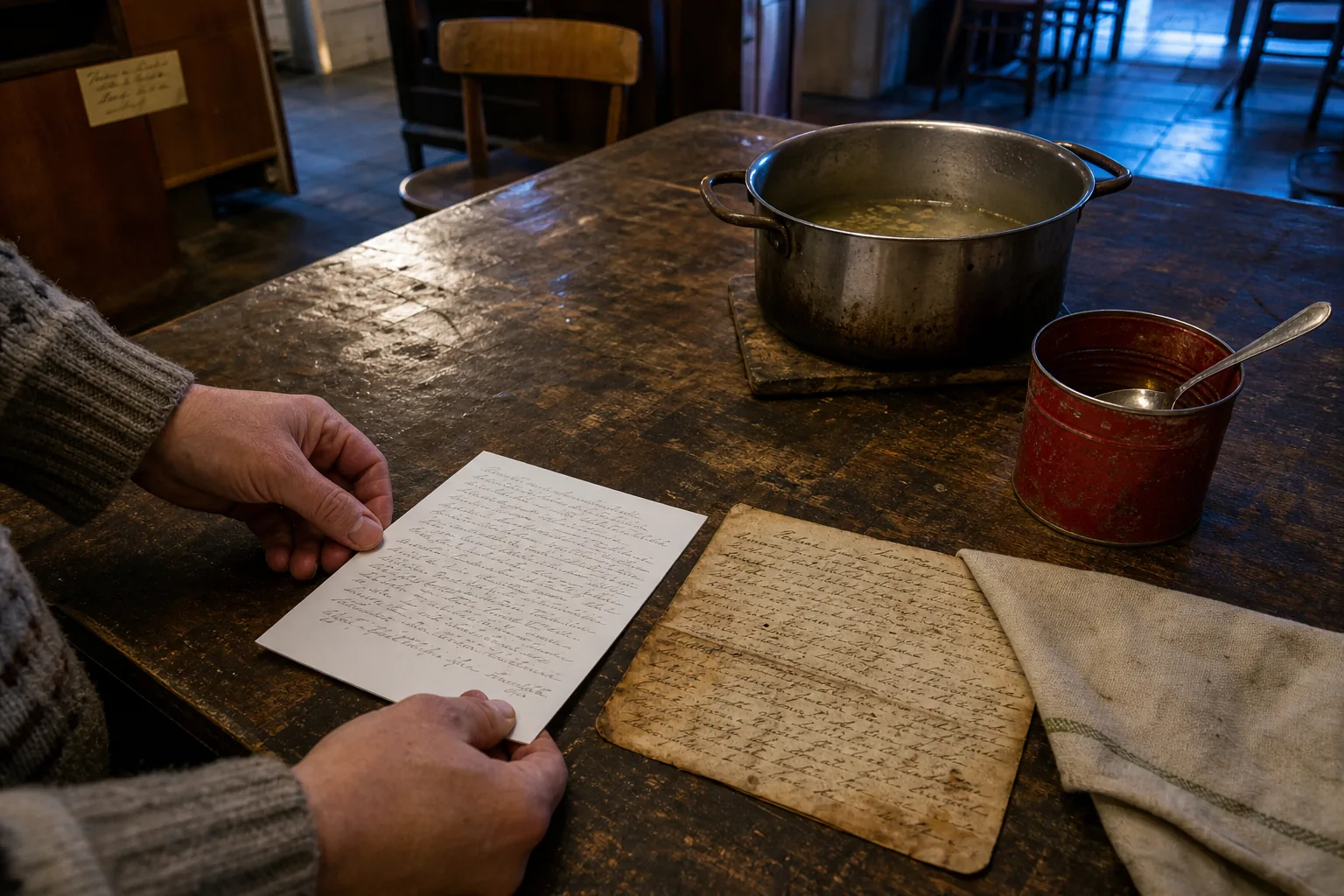
Origin stories are built for menus.
One sentence. A city. A person with a decisive apron.
Something said to have happened by accident, which is the preferred way of explaining anything that took years of labor.
They are neat because most of the people have been removed for you.
A dish may have traveled through a port, a household, a restaurant, a trade catalogue, a language and three generations of cooks before it arrives at the sentence saying it was invented one afternoon.
That sentence is not always false.
It is just often attempting a job its evidence never applied for.
A disputed origin is not the same thing as an empty history.
The useful alternative isn’t “one true owner,” and it isn’t “every story is equally good.” It is a smaller question. What, exactly, does this source show?
Records will tell you about circulation far better than they tell you about invention.
Household memory matters too, but you need a speaker, a place and a date attached to it.
That is not less romantic. It is only harder for you to put on a coaster.
Take the claim apart first
When somebody tells you a dish came from somewhere, sort the claim into three boxes.
The first box is the earliest record.
A menu. A cookbook. A newspaper item, a patent, a note in a household ledger.
A modest claim like “a 1912 menu documents this dish at this hotel” is excellent historical work.
It hands you a date, a place, and something you can go and check. It does not prove invention. It does not prove popularity.
It does not prove that nobody made the thing elsewhere before the menu was printed.
Great libraries hold cookbooks running back five centuries, along with diaries, menus, posters and manuscripts.
That is a great deal of paper.
It is not every kitchen that ever existed.
Print has always favored people with literacy, money, a publisher, and some reason to keep their papers, which describes almost none of the cooks you are looking for.
A missing recipe may mark an archival gap rather than a culinary absence.
The second box is the later popularizer.
A restaurant matters to you here.
Its menus, reviews, business papers and advertising can show what it served, where, and to whom.
An advertisement shows that a seller wanted customers.
It does not show you that the slogan was true. Commerce has been making that distinction professionally for some time.
The third box is the regional version.
This is where a dish stops being a deposition and becomes a living practice.
A family holiday version, a street-vendor version and a diaspora restaurant version can differ in ingredient, service or technique and all be authentic to the people who make them.
The three boxes do not compete.
They stop one good piece of evidence from being asked to do all three jobs at once.
A record describes its own occasion
A recipe hands you something wonderfully concrete. Ingredients, expected technique, fuel, vessel, measurements, an intended reader.
It also carries its silences.
A sparse instruction can assume trained domestic labor standing nearby. An expensive ingredient can signal aspiration rather than dinner.
A new ingredient appearing between one edition and the next may reflect editorial change, or availability, or taste.
It needs corroboration before it becomes a story about a whole population. The same caution belongs around the regional food surveys of the nineteen-thirties.
They are observations from a defined project, gathered by particular people with particular briefs.
They are not a census of American cooking, which would be a very ambitious use of a notebook.
Oral history supplies a different kind of record.
An interview preserves vocabulary, sensory judgment, technique, labor, migration and loss that print leaves out.
So attribute your speaker, your place, your date.
And if a remembered date and a surviving record disagree, keep both of them. The mismatch may be the thing that explains how a tradition acquired its meaning.
It does not automatically make a witness wrong.
One family notebook can trace a relationship without proving a regional consensus. One old book can do the same in a nicer binding.
Movement is evidence, not a cause
Food moves by trade, migration, changing borders, shared ecosystems, work and appetite.
Bills of lading, market reports, prices, shipping records, patents, advertisements, trade catalogues, menus and regulations all show access and circulation.
They are best at your small questions. When does the name first appear in local menus? How does a particular dried pasta enter a city market?
Chronology comes before causation.
If your ingredient shows up after a railway opens, the railway may have contributed. So might migration, an older trade network, or several routes at once.
“Appears in,” “is documented by,” “was marketed as” and “was associated with” are not timid verbs.
They are verbs that have read the file.
Similarity needs the same discipline.
Two foods can share a wrapper, a fermentation, a grain batter, or simply a solution to feeding people from the same limited equipment.
Direct descent needs a path you can name. Travel, trade, migration, texts, shared language, documented exchange. Resemblance on its own is a comparison, not a family tree.
A dish can travel without staying still
Named dishes are not all held together by the same thing.
Some rest on a general architecture.
Some depend on a particular treated dough, a raw material, a cut, a processing history.
Change the garnish and you may have changed nothing.
Change the starch system or the defining protein and you may have changed what the dish is.
Which is why the honest word is sometimes “adaptation.”
That is information, not an apology.
The test is small enough to use at the table
Before you repeat an origin story, make three headings. Earliest record. Popularizer. Regional version. Under each one, write your source and what it actually observes.
A dated menu may fill your first box. A restaurant’s own papers may fill the second.
An attributed interview may fill the third.
A shipping record shows access; a photograph shows a tool or a table.
Then look for the gap.
Is the alleged first source merely the first digitized one? Is the regional label really a restaurant brand?
Is a familiar word a later translation?
Could similar food have arisen twice from shared ingredients and equipment? This isn’t cynicism. It is how a story survives being repeated.
And the consequence of skipping it isn’t a footnote problem.
A menu can turn a charming invention into a fact, and erase the cooks, the migrations, the adaptations and the ordinary decisions that made the dish recognizable in the first place.
The better origin line will be longer.
It says where the name is documented, who popularized a version, which communities carry it now, and what is still unknown.
Which is a worse coaster and a much better sentence.