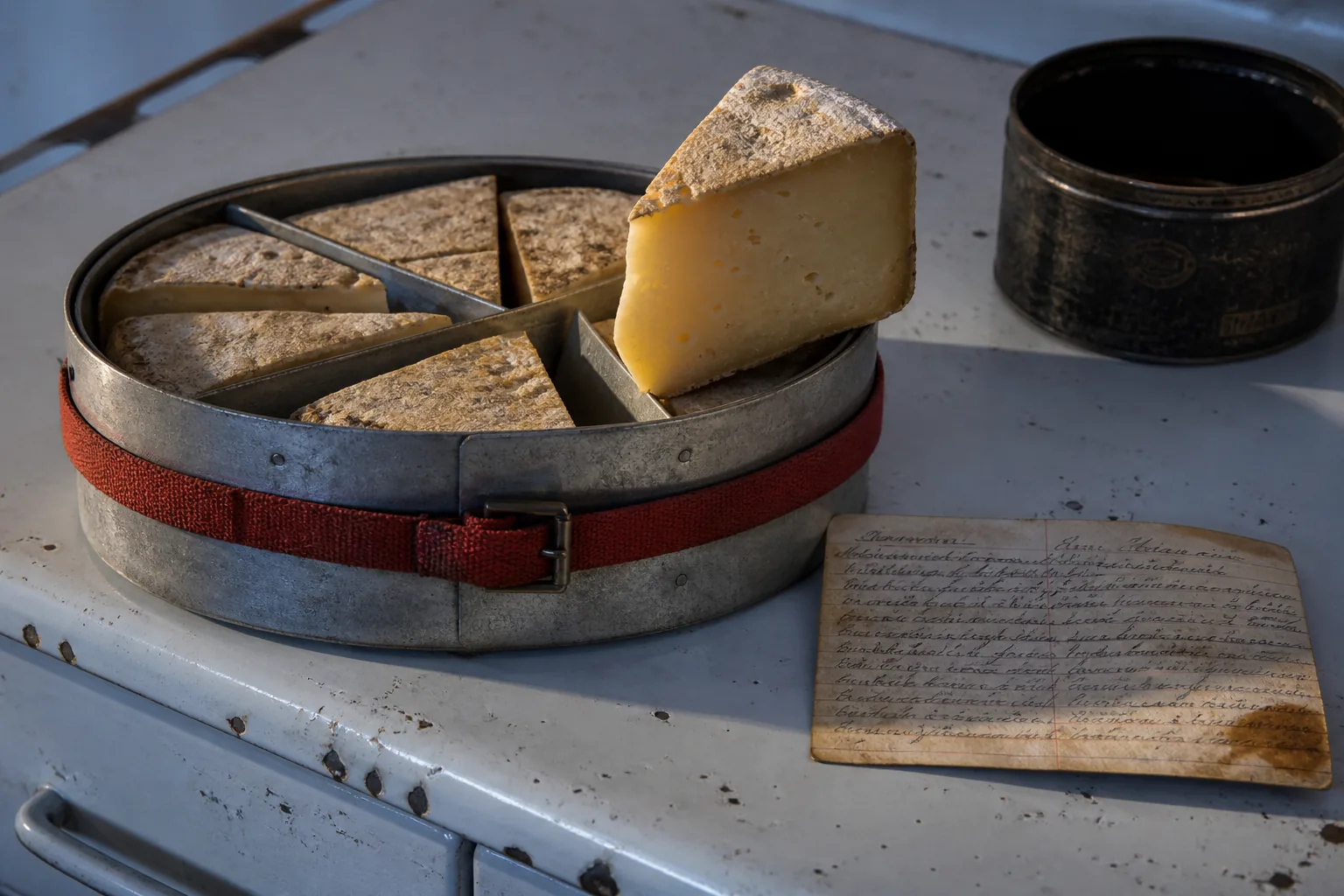
There is a particular confidence that arrives with a protected cheese name. It is spelled correctly. It has an accent, possibly. It has survived a committee.
It has a reputation sturdy enough to make you feel you have brought home the answer rather than a dairy product.
That confidence is reasonable.
It is also only the first half of the purchase.
A protected name can tell you where a rule begins; it cannot tell you whether this wheel is the one you want.
This is not a complaint about designations.
Provenance is real information. A farm, a region, a breed, a supplier relationship, a season, a documented method.
A producer who can say “made with milk from these named farms” has told you more than one offering a pastoral adjective and hoping you won’t ask again.
But provenance is a relationship, not a tasting note.
It does not replace milk, moisture, acidity, curd structure, salt, age, rind, format or storage.
And it cannot make a washed-rind cheese behave like a fresh goat cheese by having excellent paperwork.
The name governs the beginning
Cheese starts as milk, cultures, curd, drainage, salt and time. The make process gives it its family resemblance. Acid-set fresh cheeses come out tender and crumbly.
Rennet-set and stretched-curd cheeses come out elastic. Pressed cheeses go firm and sliceable.
Pasta filata curd is heated and stretched, which is why mozzarella pulls when its moisture and fat and heat all agree.
These are not small differences hiding behind a romantic name.
They are the machinery.
Ricotta, cottage cheese, cream cheese, fresh goat cheese, paneer and queso fresco all hold a lot of moisture.
But paneer is built to keep its shape under heat, ricotta softens into a filling, and cottage cheese will release liquid into whatever you put it in.
The word “fresh” has already told you less than the make process did.
Milk gives you another clue, not a verdict. Goat’s milk becomes fresh, firm, aged, blue or bloomy.
Sheep’s milk supports rich, dense cheeses.
Cow’s milk covers an enormous commercial range because it is widely available, not because it won any dairy elections.
If your recipe wants a dry salty grating cheese, an aged sheep’s-milk cheese may serve you better than a fresh cow’s-milk one.
That is not heresy. It is dinner.
Then affinage keeps working on it.
Moisture leaves. Enzymes and cultures and the developing rind reshape the paste.
A young cheese is milky and elastic and lactic. An older one goes firmer, nuttier, sharper, more crystalline.
Age is not a ranking system wearing a nicer label. A fresh cheese isn’t unfinished. An old cheese isn’t automatically better.
Each style has a useful window, and an age statement on the label is a claim about that cheese, not a promise that your palate will be pleased.
So the first question after admiring the designation is simply: what stage of its life is this piece in?
Rind is a process, not punctuation
Soft-ripened cheese develops from the surface inward.
A Brie-style wheel can be chalky in the middle when young and flowing later, under an edible bloomy rind.
Washed-rind cheese gets washed repeatedly during aging.
It may go orange or pink at the surface, smell considerably more assertive, and turn supple or spoonable inside.
Both are soft.
They are not the same kind of soft, and neither is reliably the stronger one.
Blue cheese ripens internally, veined blue or green, bringing salt and tang and mineral pungency across a range from creamy to crumbly.
A bloomy cheese does its ripening at the surface instead.
A little blue makes a dressing forceful. A bloomy cheese adds creaminess and can turn oily under aggressive heat.
Which is why “a nice protected cheese” is not a usable instruction. For a sauce, a small amount of aged grating cheese will season the whole pan.
The same weight of fresh mozzarella mostly changes the moisture and the melt.
The designation does not make those two jobs converge.
Rinds don’t share one rule either. Natural, washed, bloomy, clothbound, waxed, ash-coated, plastic-coated. Some are meant to be eaten.
Some are protective.
Some are edible in principle and disagreeable in practice, a category with a great deal to teach us.
The maker’s guidance is a better authority than bravado at the board.
Read the name, then read the cheese
Ask what milk it uses and how the curd was made. Ask whether it is fresh, soft-ripened, washed-rind, blue, pressed, hard or pasta filata.
Then ask what you actually need it to do.
Spread, slice, cube, grate, melt, stretch, brown, or hold its shape under a broiler. Ask about the rind. Ask whether the wheel is young, ripe or long-aged.
Look for a batch code, a date, storage directions.
This isn’t fussy shopping.
It is where the production rule finally meets the wheel that traveled to your counter.
Format changes the result too. Whole wheels, wedges, blocks, shreds, slices, crumbles, spreads. Pre-shredded cheese may carry anti-caking agents.
Thin slices melt differently from a grated wedge.
The inside of a wheel and a cut face do not age the same way once you get them home.
Format is not a failure of authenticity. It is a cooking decision. The same goes for processing. Natural cheese is curd formed, drained, salted, usually ripened.
Processed cheese combines cheese with controlled heating and, in some products, emulsifying salts. The second one melts with remarkable predictability and keeps well.
This is not real versus fake.
It is a burger question, a sauce question, and a label question, and you are allowed to want different answers on different nights.
One safety rule is worth carrying, because it is specific and people get it backwards.
Mold on soft cheese means the cheese goes.
Mold on a hard cheese that was never meant to be moldy means you cut away about an inch around and below the spot and keep the rest.
That rule does not extend to shredded, sliced or crumbled cheese, where the mold has more of the cheese to itself than you can see.
Categories remain annoyingly determined to matter.
Scale explains the journey, not the verdict
“Small-batch,” “hand-formed,” “traditional” and “local” can all describe something real.
They cannot do everything people ask of them.
Scale might mean batch size, or staff, or production days, or distribution radius.
A tiny run allows flexibility and direct feedback.
A larger run offers reliable availability and quality systems and a lower price.
Neither settles the question of craft.
Small producers use shared kitchens, wholesale ingredients, automated equipment, contractors, co-packers. Those arrangements often make a cheese better and more available.
The line that matters is transparency, not scale: a producer should not imply it hand-finishes work done somewhere else.
Packaging belongs in the same frame. It protects, labels, transports and sometimes extends shelf life.
A deli cup, a vacuum pack and a whole wheel are not three costumes for the same virtue.
Trust, in the end, is the ability to answer a question.
What was made. Where the inputs came from. How it should be stored. Which claim can actually be checked.
A designation is meaningful evidence of a defined provenance and method. Usually.
Usually is doing honest work in that sentence.
Quality still depends on the batch, the affinage, the storage, the condition, and your own taste on the day.
A seal cannot promise that this wedge was kept well, that its rind suits your meal, that its age is right for its style, or that its particular salt and aroma are what you wanted after a long day.
So buy the protected cheese, if the protection is telling you something you needed.
Then give the cheese the courtesy of being itself.