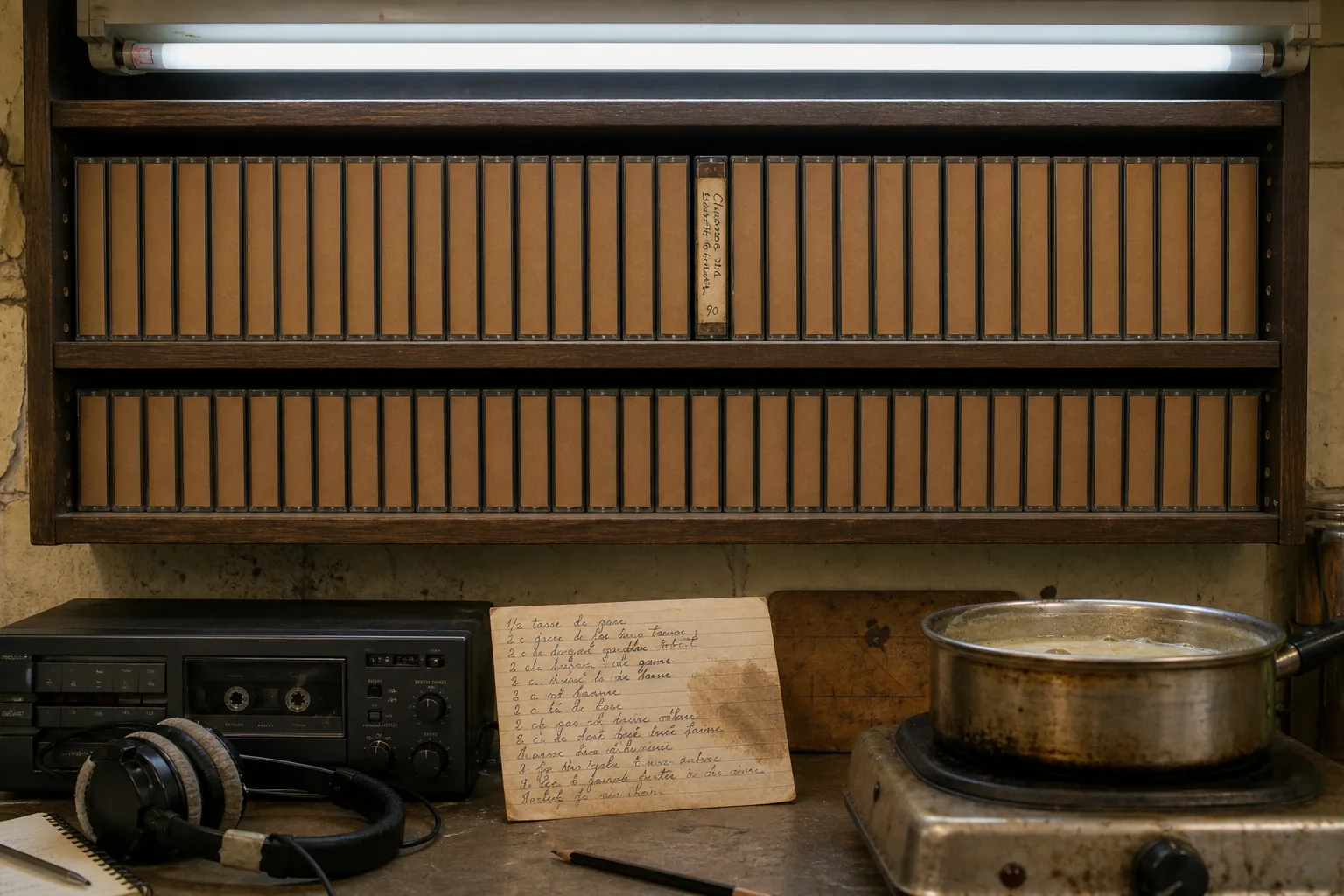
There is a particular confidence that arrives with a slow tracking shot, a close microphone, and music lowering its voice as though it has seen the paperwork.
Then comes an account of what happened.
It may be a sensible account. It may even be the best account anyone has. But a camera arriving later can’t make a moment witnessed.
Neither can a pair of headphones.
An actor’s footsteps on gravel. A telephone ringing under a remembered conversation.
A little room tone placed around a sentence.
Audio builds a place so efficiently that your mind furnishes it before you have thought to ask where the furniture came from.
The useful distinction is a reconstruction can explain a theory; it cannot become the record of it.
That isn’t an argument against reconstruction.
Some accounts are genuinely complicated, and a tangle of documents and dates and competing memories is hard to hold in your head without help.
It is an argument for telling you the moment help has turned into illustration.
Tape and a made scene weigh differently
Original tape is material recorded for or during the documentary. A voice, an event, an environment.
Archival tape comes from an earlier recording or collection.
Both can be partial. Both can be edited.
A historical clip is evidence of what was recorded or broadcast, not a small gold seal certifying every claim inside it.
Reconstruction is a third thing entirely.
It may use actors, scripted readings, sound effects, composite dialogue, animation, staged scenes, synthetic audio.
All of that can make an account comprehensible.
None of it turns a conversation nobody recorded into evidence that it happened in those words, in that order, with that pause before the answer.
The pause is doing a great deal of work there. So is the soundtrack. Music, room tone, effects, archival noise and silence are not decorative trim.
They are editorial claims about how you should feel. Danger. Guilt. Grief. Inevitability. Relief.
That may be a fair response to the evidence.
It may also be a very persuasive substitute for it.
The label has to arrive on time
A reconstruction caption at the top of a film, or a credit tucked in after the last episode, is better than nothing.
It is usually not enough.
You need the label inside the sequence, at the point where the source changes the meaning. Reconstruction. Actors.
Composite audio. Scripted reading.
And a good label does two things at once: it names the device, and it says the scene represents an account rather than a captured event.
“Reconstruction from witness testimony” will do it.
This isn’t fussy labeling for people who collect tiny print.
It is the difference between being told a scene represents somebody’s account and being allowed to believe the production was standing in the room.
The more realistic the device, the more clearly it needs naming.
That matters most in an active case, where charges and rulings and witness accounts can all still change, and where the consequences land on people who are alive to feel them.
So the test is modest. When a dramatic scene appears, look for its source right then.
If the sequence names actors, a reconstruction, composite dialogue or illustrative material, you can judge the device for what it is.
If it doesn’t, treat the scene as argument rather than record. That is not cynicism. It is keeping the labels on the jars.
Editing can make time behave too neatly
Every documentary edits. It selects, shortens, orders, repeats, juxtaposes and leaves things out.
That is how a documentary becomes a documentary instead of a basement full of hard drives.
Editing can also create causality, agreement, suspicion or resolution that the underlying material never established.
A witness statement recorded years afterward can sit beside the event and feel contemporaneous. A montage can make two people appear to answer each other.
An interview can be cut so tightly that a qualification vanishes and the certainty arrives freshly pressed.
No fake words are required for any of it.
Date cards, narration and source context are the counterweights.
They separate what was known at the time from what was learned later.
What a participant remembers from what a document records. What the filmmaker infers from either.
Document, testimony, inference. A sequence can hold all three. It should not blur them.
The same goes for a calm narrator. First person can name a reporter’s relationship to a subject.
Third person can sound neutral while making very strong interpretive choices.
A composed voice is not evidence.
An upset voice is not a defect in evidence.
The question stays the dull useful one. What supports this claim?
Where a scene learns manners
A responsible crime documentary distinguishes documents, interviews, witness accounts, official statements, expert analysis, archival reporting and its own inference.
In audio the distinction may live in narration, show notes, transcripts, credits.
On screen it may be an on-screen citation.
Ideally you get both: attribution in the scene, and a note where you can go and assess the material yourself.
None of this makes a film bloodless. It makes the argument inspectable, which is a different thing.
An official statement is an official account, not proof of everything inside it. A family member’s testimony can be essential personal evidence without becoming a general record.
One interview illustrates an experience; it does not establish a fact about everyone.
Oral history preserves memory, culture, work and change.
Investigative reporting tests a question through records, multiple sources, response and verification.
Both deserve respect.
They are not interchangeable jobs with different stationery.
Polish is not a current record
Films and episodes get revised.
A new edit, a corrected transcript, an updated show note, a replaced feed, an added introduction.
Older downloads, clips and quotations keep circulating anyway, indifferent to all of it.
So before you rely on an account, check the release date, the version you have, and whether anything has been corrected since.
An award, a trailer, a review, a ranking or a platform page is promotional context. None of it certifies that the account is accurate, complete or current.
And none of this requires you to stop being moved. The whole point of the form is that it moves you.
A reconstruction exists because somebody wanted you to feel the weight of a thing that happened to a real person, and that impulse is not the problem.
The problem is only ever the missing label.
Watch for where the record stops and the argument starts. It is usually about four seconds before the music comes up.