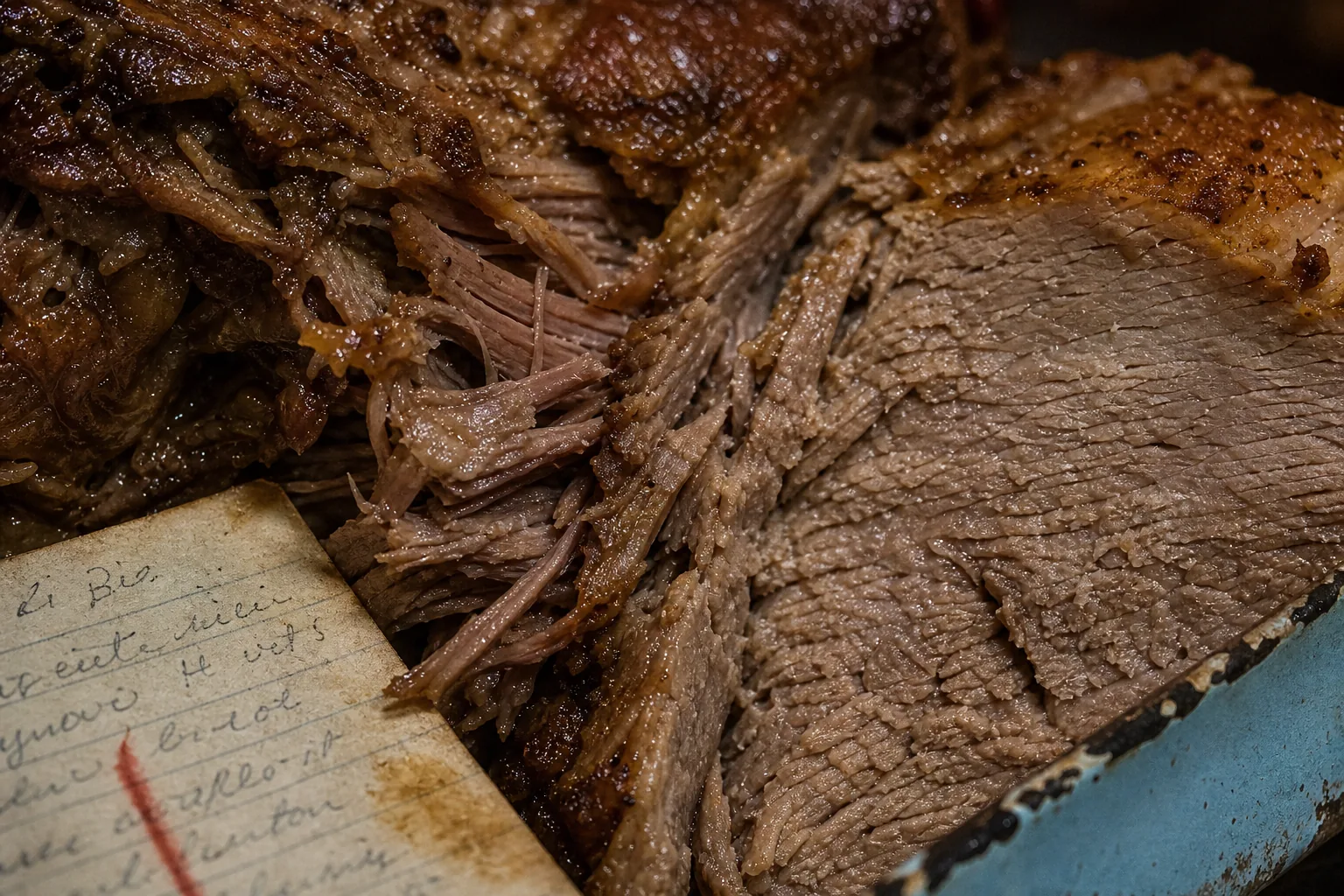
There is a kind of chewy meat that makes you feel betrayed. You put it in the pot hours ago. It’s still resisting the fork.
Surely the sensible thing is to leave it in there until it stops.
There is another kind of chewy meat that makes the same request in a different costume. It was a loin chop. A tender steak, nicely marbled.
It has been cooked past the point where it was juicy, the fork meets resistance, and the temptation is to give it more time.
Reasonable enough. Both pieces are chewy in your mouth.
It is also how one dinner goes dry while another gets served ten minutes before it would have been tender.
A collagen-rich cut needs time and moisture; an overcooked tender cut needs neither.
So the question isn’t “is this meat tough?”
It is “what is making it feel tough?”
A cut arrives with its own instructions
Tenderness starts long before you, with the muscle’s working life.
How much it moved, how much connective tissue it carries, the fat, the grain, the thickness, and how you slice it afterward.
Loin and rib muscles are usually tender enough for dry heat on their own. Tenderloin, strip loin, rib-eye, most pork loin chops, lamb loin chops.
Those belong under your broiler or in your pan, with a thermometer somewhere nearby.
Chuck, shoulder, shank, brisket, cheek, neck, tail and ribs are different animals in the useful sense.
They carry far more collagen than anything you would grill.
Long gentle heat with moisture converts that collagen to gelatin, which is why a braise goes from firm to yielding rather than proceeding steadily from raw to regrettable.
The two methods are not a hierarchy.
They are assignments.
A thick rib-eye and a chuck steak of the same thickness will look like cousins in your butcher’s paper.
Their connective tissue gives them entirely different futures.
One wants a target temperature and a rest.
The other wants a covered pot and enough time for its structure to change.
Price will not interpret any of it for you.
Neither will the word “premium,” which has had a very full career for such a small word.
Safety and tenderness are separate questions
An intact beef, pork, veal or lamb cut is safe at 145°F, followed by three minutes of rest.
Ground meat wants 160°F, because grinding moves the surface through the whole thing. Those numbers matter because nothing you can see answers that question reliably.
Not clear juices, not color, not the smell, and certainly not the memory of a timer.
But a chuck roast at 145°F is safe and nowhere near tender. The thermometer answered a different question from the one you were actually asking.
For an uneven roast or a bone-in chop, put a clean probe into the thickest part and keep it out of the bone and the fat pockets.
A number taken in the wrong place is a small piece of information pretending to be a conclusion.
Texture needs its own test.
For a braise: does a fork meet yielding meat, do the fibers separate, is it juicy after its rest?
For a steak or a loin chop: check doneness, rest it, slice it, and feel what the fibers do.
Those two tests can disagree with each other without either one being wrong.
The braise has to be a real braise
Time alone will not soften collagen for you.
The cut needs sustained gentle heat, and it needs enough moisture, and it needs to stay there long enough for connective tissue to give way before the muscle has surrendered all its water.
That is a process with three requirements, and a low oven with the lid off satisfies one of them.
So a shank that is safe and still firm has not failed you. It needs the braise continued, gently, and checked again by fork rather than by clock.
The endpoint is a texture, not an hour borrowed from a different cut.
Thickness, marbling, the amount of liquid, the particular muscle and how you intend to slice it all move the actual endpoint around.
The clock is useful when it’s tied to an event. When the simmer started. Whether the pot was covered. What the fork found last time.
It is much less useful when left alone to supervise the kitchen.
The quick-cooked cut cannot be argued with
An overcooked tender cut has already lost the thing your extra heat cannot bring back.
Your searing did not seal in any juices.
Browning gives you color and flavor; moisture keeps leaving according to heat and time and geometry.
The surface may be handsome and the middle may still have had a difficult afternoon.
This is where the diagnosis has to get a little stern with you.
Do not keep cooking a tender steak in the hope that it becomes moist again. Resting helps when it follows successful cooking. Slicing immediately makes things worse.
But “rest it” is less an instruction than a postcard from one: off the heat, tented rather than sealed, on a rack or in a warm dish.
Then look at the grain.
Long visible fibers get much easier to chew when you slice across them instead of along them.
Flank, skirt, hanger and some blade cuts reward thin cross-grain slicing enormously. A braised roast benefits too.
If the tender cut is already dry, thin cross-grain slices and a sauce are a recovery. They are not a reversal. The dinner can still be good.
It simply has to stop waiting for a transformation that isn’t coming.
Thickness changes the route
A thin cutlet cooks through in a pan. A thick chop wants lower or indirect heat after it browns.
Which is why two pieces of the same weight can need completely different instructions. One may be thin and broad. The other compact and deep.
Weight tells you nothing about the distance from a browned exterior to a properly cooked center, and that distance is the entire problem.
Bone changes your picture again.
It adds structure, flavor, insulation and irregular thickness, and a bone-in roast does not yield its purchase weight in cooked slices.
Fat has separate jobs too. Marbling sits inside the muscle and gives you perceived juiciness in a quick-cooked steak.
Seam fat sits between muscles and needs either trimming or long cooking to render.
A fat cap can protect a roast or be removed, depending on what you want from it.
None of them is a pardon for overcooking.
A well-marbled steak can still be dry.
A lean leg cut can be excellent, cooked gently and carved thinly across the grain.
Diagnose before you rescue
When the meat feels chewy, work out what you are holding before you touch the dial.
Shank, chuck, brisket, cheek, shoulder, neck, tail, ribs, in a genuine moist braise?
Test for fork tenderness and separating fibers. If it hasn’t yielded, gentle continued cooking is the repair.
Tenderloin, strip loin, rib-eye, a loin chop? Thermometer in the thickest part, proper rest, slice across the grain.
More cooking is not a tenderness strategy and never has been. The fact that both pieces feel chewy is an unhelpful coincidence.
One is still on its way.
The other has already given you everything it had.