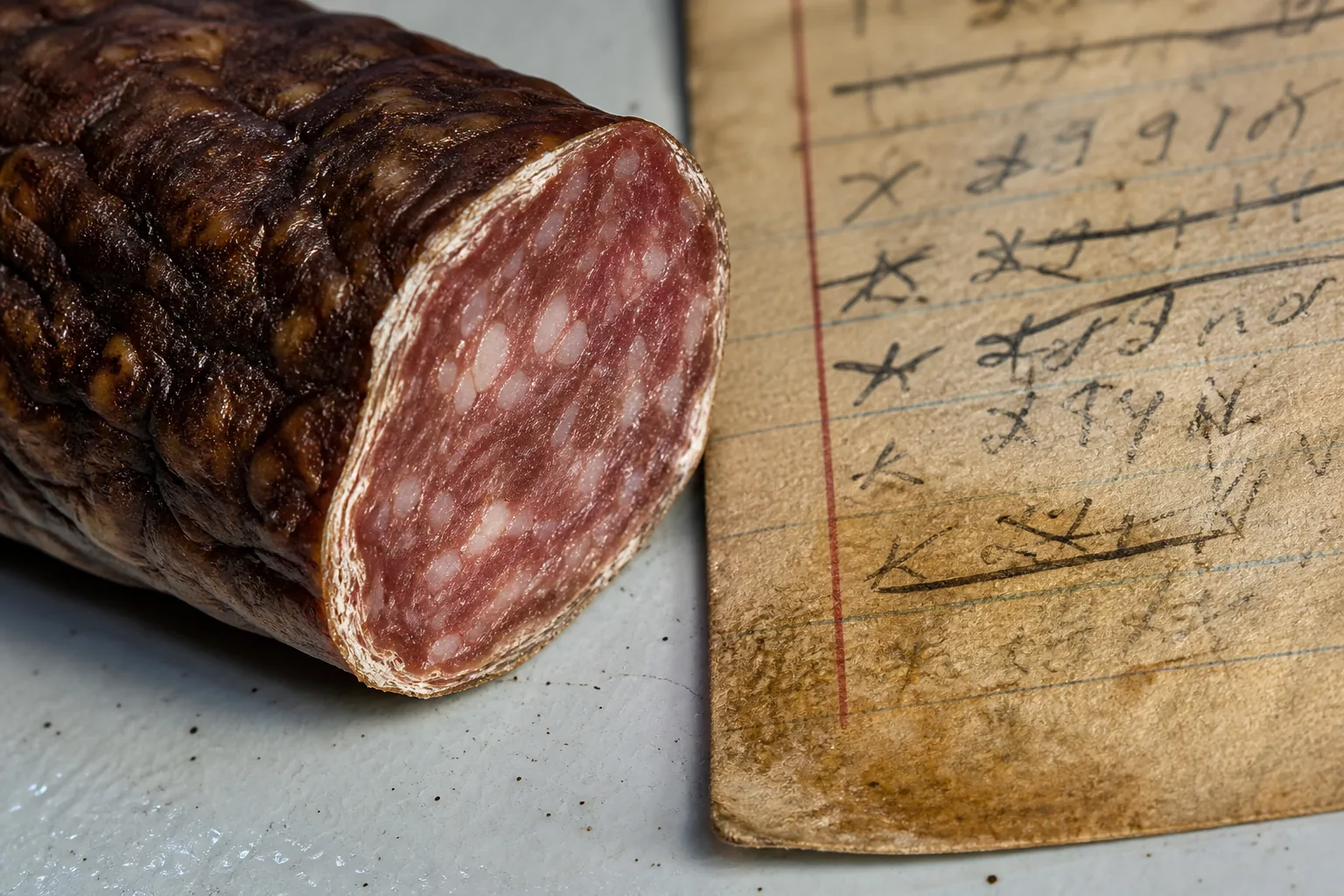
Salt has a persuasive manner.
Smoke does too.
Add a firm rind, a little time, maybe the gray-white bloom on a dry sausage, and a piece of meat can look as though it has completed a course in self-possession.
It may have.
That isn’t the same as being safe for you to leave in a cupboard. The distinction is cure gives charcuterie its character; a validated process establishes its preservation.
The mistake is reasonable, because the two systems meet in the same place.
Salt, time, drying, smoke, sometimes fermentation, sometimes a casing doing an excellent impression of certainty.
But those are ingredients in a process.
They are not proof to you that the process happened.
A dry sausage is meat mixed with curing ingredients and lactic-acid bacteria, fermented in casings, then dried under controlled conditions.
That sentence carries more safety information than a handsome slice ever will. It names the cure, the culture, the fermentation, the drying, and the control.
Cured describes a treatment, not a storage instruction
Salt seasons meat, pulls out moisture, and helps make conditions some microorganisms dislike.
Curing salts do something else again.
Nitrite in bacon delays the development of botulinum toxin and slows rancidity, and that is a specific safety control rather than a flavor note.
It is not the work ordinary salt does, however much a recipe would like them to be cousins sharing a coat.
Smoke adds aroma and color, and where heat comes with it, it can be one hurdle among several.
Spice makes a product recognizable. A firm dry surface makes it satisfying to slice.
None of those observations tells you whether the thing is raw, ready to eat, refrigerated, or shelf-stable.
Those are different attributes, and only one of them is visible.
Fresh sausage is raw ground meat and fat.
It belongs in your refrigerator and in your cooking plan: 160°F for pork, beef, lamb or veal, 165°F for turkey or chicken.
Dry sausage is fermented and dried under controlled conditions.
It may be ready to eat, and it may be shelf-stable, if it was manufactured and labeled that way.
The word “may” is doing honest work in that sentence.
Dryness tells part of the story
Drying removes moisture.
It concentrates the meat and the fat and the salt and the spice, and it makes the product firmer and easier to slice.
That is why a small amount of it tastes like a decision. It doesn’t let you infer shelf stability from texture, however confident that texture feels.
“Dry” is an observation about process and feel.
“Shelf-stable” is a claim about a completed process, package integrity, the temperature and humidity it will sit in, and a manufacturer-specified shelf life.
The first one you can feel between your thumb and a knife.
The second needs evidence.
This is also why a whole-muscle cured ham and a ground salami do not give you the same clues.
One keeps the grain and the fat of an intact cut. The other distributes lean, fat, salt and seasoning through a mix.
Thin slices, visible fat, a dense interior, a good chew: those describe service and texture.
They are very bad paperwork.
The controls do not travel alone
Salt amount and distribution, time, temperature, pH, water activity, heat treatment and packaging all interact.
For drying, so do thickness, air movement, drying temperature, the endpoint, the package and the storage.
No single one of those is safe by itself, which is the whole reason the word “system” keeps appearing.
This is where your home project gets vulnerable to optimism.
A process held longer, made with a different grind, packed into a different casing, or dried to a different endpoint is not the same process with a more interesting biography.
It is a different set of conditions, and they are yours.
Preservation guidance says this in another accent, and it says it about everything, not only meat.
A tested instruction is decided for the recipe as tested. Doubling it’s not automatically safe.
A thicker purée does not heat like diced food.
A larger jar does not earn a longer safe process by arithmetic. Those are canning examples, and the habit underneath them transfers cleanly.
An appealing adaptation can still alter a safety-critical relationship, and it will not look any different to you while doing it.
Numbers here are conditions, not souvenirs.
A culinary repair is not a safety repair
Suppose the thing you cured comes out too soft, too wet, not concentrated enough.
More drying may improve the slice. More salt may make the flavor seem more decided to you.
More smoke may make it seem finished, which is a powerful effect and occasionally a nuisance.
Those are culinary repairs, and they may well work.
What they don’t do is establish that the formula, the culture, the time, the temperature, the pH, the water activity and the storage plan now form a validated system.
Commercial ready-to-eat fermented and dried products use several hurdles at once. Fermentation, cure, drying and acidity working together to establish lethality and stability.
That is an argument for evidence rather than an argument that industrial scale is morally cleaner than craft.
A small producer may have controls a great deal more rigorous than yours. A large one may make something wonderful.
The question is the same either way: were the stated process and storage conditions controlled, and were they followed?
The home version has usually not reproduced those controls by reproducing salt, time, and the very convincing smell of smoke.
The package has the last practical word
Ready-to-eat means the product can be eaten without further preparation to make it safe.
It does not mean shelf-stable.
A factory-sealed dry salami, a deli-sliced salami, a refrigerated cooked ham, a fresh raw sausage and a canned pâté can all appear under the generous umbrella of charcuterie.
Their handling after you get them home is not interchangeable.
So the package tells you what the product claims to be, and what happens once it is open.
“Cook before eating,” the refrigeration directions, the storage instructions: those outrank a board’s general air of European confidence.
A seal settles nothing for you either.
A jar from an untested process can be unsafe sealed or unsealed. A closure says something about packaging integrity and nothing about whether the treatment was adequate.
So pick your preservation goal first. Refrigerated. Frozen. Dried. Fermented under stated conditions. Shelf-stable and canned.
Then use a current tested instruction that names the food, the preparation, the package, the equipment, the process and the storage.
If it does not explicitly allow your alteration, make the food fresh instead. That is not less romantic than curing meat by instinct.
It is the part that lets the romance survive contact with Tuesday. Ask for the measured salt, the time, the temperature and the storage plan.
If the only answer available is that it tastes cured, put it in the refrigerator and enjoy it there.