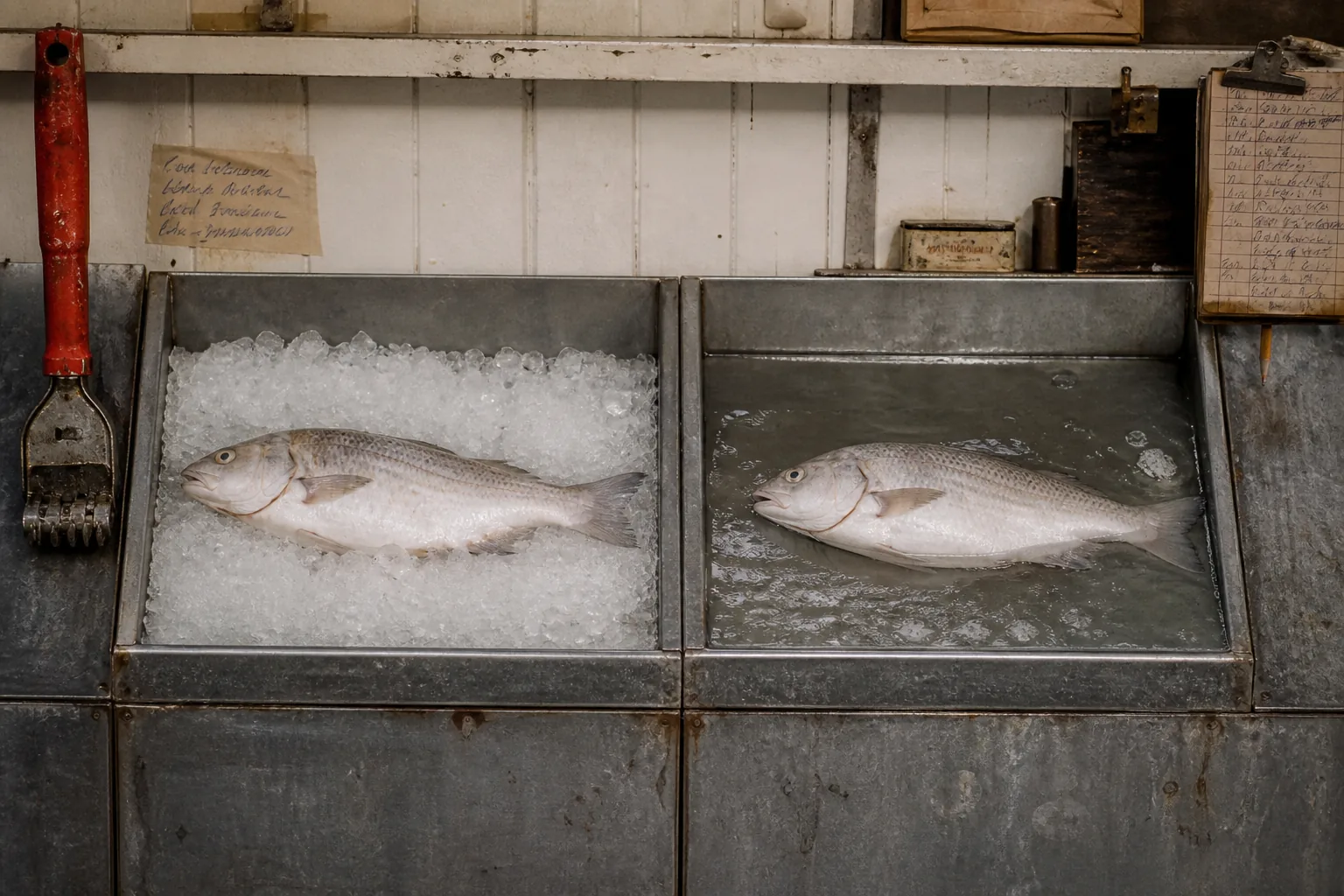
There is a small ceremony people perform at the fish counter.
You look at the eye.
You lean in, carefully, and smell.
You press the flesh.
You take in the shining skin, the ice, the general impression of a creature that has not yet had a difficult week.
None of this is foolish.
Clear eyes, a mild odor, firm flesh and cold storage are useful signs. The trouble starts when you ask them to do a job they cannot do.
A fish that looks fresh is a visible condition; freshness is a chain of handling.
The eye tells you something about the fish in front of you.
It cannot supply its biography.
It cannot tell you when the fish was caught, how long it spent in transport, whether its temperature held, whether it was frozen near harvest, or how long it has been lying in that case.
It also cannot perform a pathogen test, which is perhaps asking rather a lot of an eye.
This isn’t an argument for shopping with a clipboard.
It is an argument for treating the glance as the beginning of the question rather than the answer.
The counter is the last visible part of a chain
A market is not a row of stalls. It is a flow. Harvest, cooling, sorting, packing, aggregation, transport, unloading, setup, display, sale, and then your drive home.
Temperature control matters across all of it.
So do containers, loading access, timing, refrigeration, and the unglamorous decision about how much product to bring today.
The display is where all that work turns into a clean tray, a price, a species name, and a fish with a promising face.
The problem isn’t that the display tells you nothing.
The problem is that it tells you the final chapter.
So ask when the fish arrived and how it has been held. Ask whether it was previously frozen.
Ask for the actual species rather than “white fish.”
Then look at the flesh, the cold case, the labeling, and whether the counter is selling enough to keep turning over.
Several signs together beat one sign every time.
A seller may know a great deal, or may know only what came in on the truck.
Good information is specific and truthful, and it does not stretch a broad local label into an affidavit.
Also: a busy line is not the moment to request a logistics seminar. Markets are allowed to contain labor.
Ask about temperature history
The most practical question is not “is this fresh?”
Every counter has an answer ready for that one.
Ask when it arrived, and how it has been held since. Then check the answer against what you can see. Firm flesh. Mild smell. Cold storage.
Intact packaging where there is packaging.
At the home end, the guidance is blunt and worth knowing: seafood held at 40°F or below gets used within two days of purchase, or frozen for later.
That does not make two days a magic property of fish. The package date and storage instruction still matter.
What it clarifies is your job. Buy only what you can chill promptly, cook promptly, or freeze.
“Fresh today” is not wrong because it is vague.
It is incomplete because today started at the counter, not at the boat.
And the last link is yours.
Keep raw seafood away from ready-to-eat food, protect it in transit, refrigerate it promptly.
A superb display cannot follow the fish into a warm car and negotiate on its behalf.
Frozen can preserve a better point in the chain
This is where the word “fresh” becomes actively unhelpful.
Frozen seafood can equal or beat a display fillet when it was frozen close to harvest. The comparison that matters is product condition and temperature history.
Not whether one item is frosted and the other reclining on ice under flattering lights.
Look for intact packaging, and avoid anything showing extensive thawing or freezer burn.
Frozen portions also make buying more exact, which helps when the alternative is a whole display fish that has quietly become a household deadline.
Thaw it in the refrigerator when you can.
When you can’t, a sealed bag in cold water works. Microwave defrost is for seafood you are cooking immediately afterward.
Counter thawing is not a clever third option. It is raw seafood being asked to manage itself.
Once thawed, treat it as perishable raw seafood. The freezer paused the story. It did not rewrite it.
Species tells you what shine cannot
Freshness is not the only category that gets flattened at a counter.
“White fish” can cover several species. Wild-caught and farm-raised describe production, not freshness and not quality.
A shiny salmon and a shiny cod are both shiny, which is not the most useful thing about either of them.
Species tells you about fat, muscle structure, thickness, flavor and how the thing is usually cooked.
Oily fish, like salmon and mackerel and sardines, take grilling, broiling, roasting, smoking and curing well.
Lean fish, like cod and pollock and most flatfish, cook faster and dry out under the same treatment.
That is a cooking distinction, not a hierarchy. Nobody at the counter is ranking them, and you shouldn’t either.
Thickness matters more than species for timing, though.
A thin fillet cooks through long before a thick steak from the same fish.
Whole fish complicates it again.
Skin and bones and the cavity protect moisture; fillets expose more surface and dry faster.
A recipe written for a whole fish does not become a recipe for two fillets by division.
At the stove, put a thermometer in the thickest part when the endpoint matters: 145°F for fish and shellfish.
Opaque flakes and firm shellfish are useful observations.
They are not a better number.
The work continues after the purchase
There is a tempting idea that careful shopping finishes the job.
It starts it.
The fish did not become less perishable because its eye was clear. It only made a good first impression.
That counts for something.
A counter that keeps its product cold and moving is telling you something real, and you should reward it with your business.
It is simply not enough on its own to carry the whole case, and it was never designed to.
Ask the second question. The good counters like being asked.