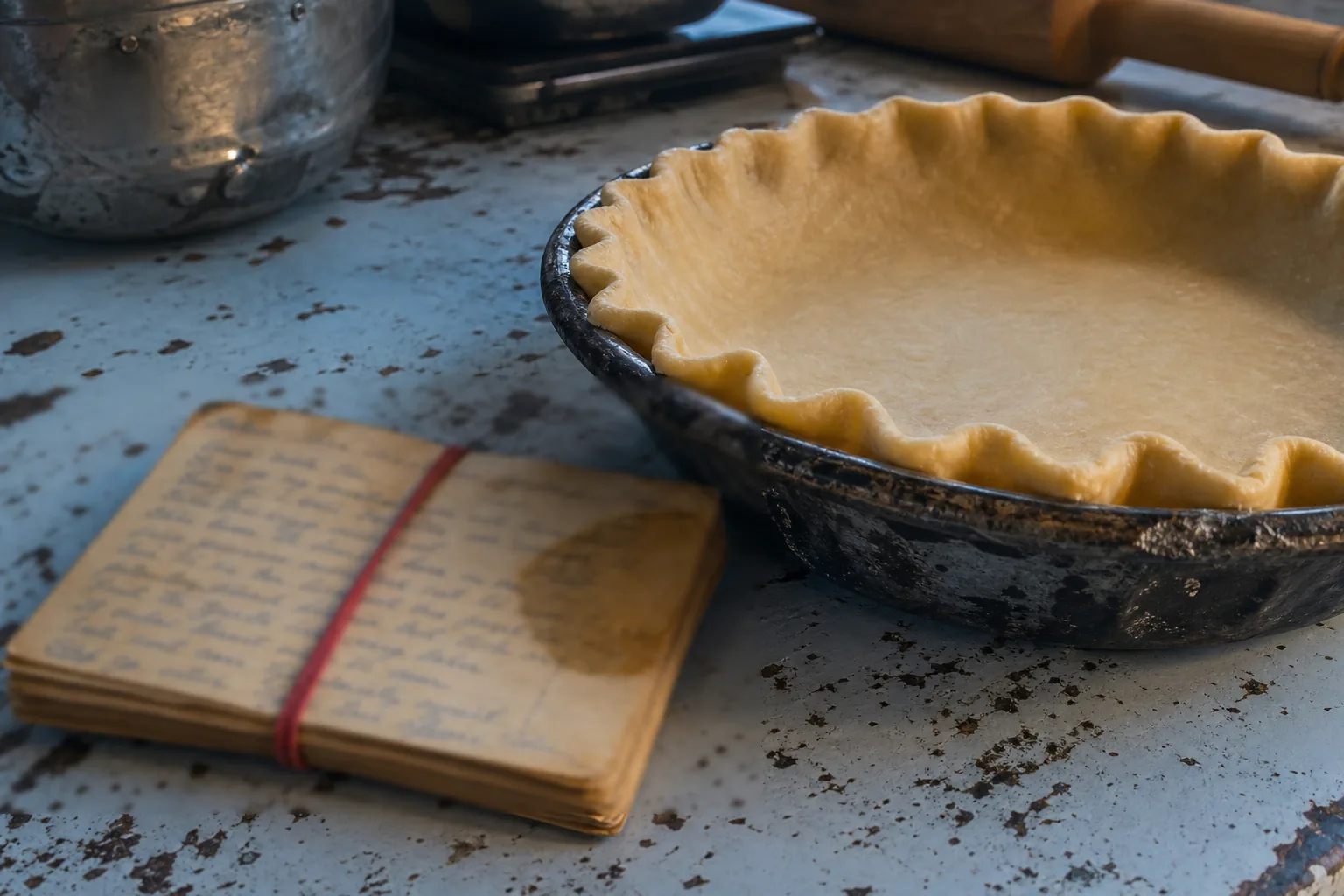
There is a moment in pastry making when the dough looks discouraging.
It’s rough. It is crumbly.
It is not behaving like bread dough, which has the considerable advantage of being the thing bread dough is supposed to be.
So your hand goes back in.
More kneading, surely, will make it smooth.
It will.
That is the trouble.
Bread needs gluten strength to hold gas; short pastry needs gluten restraint to stay tender.
The ingredients overlap so completely that the mistake is entirely reasonable. Flour meets liquid. A dough appears.
And you have been trained to read a smooth elastic mass as evidence of virtue.
For a loaf that has to ferment, rise and survive the oven’s first expansion, it usually is.
For a pie shell, it can be the moment the dough starts quietly arranging its own failure.
The same word means different things
Bread gets kneaded or folded because the dough has to hold fermentation gas and then direct that expansion in the oven.
The network you build is the thing doing the holding. Without it a loaf grows and then spreads out across the tray, looking betrayed.
Now bring the same instinct to pastry and watch it stop being useful.
The liquids alone should warn you. Milk, buttermilk, egg, vinegar, vodka and water do not contribute the same things.
They bring different proportions of actual water, and also protein, acid, alcohol and fat.
So a pastry dough that looks dry is not necessarily asking to be kneaded.
It may be asking to be pressed together and then left alone long enough for its moisture to spread out on its own.
That is much less satisfying to the hands.
It is considerably better for the crust.
Short pastry succeeds by stopping early
For a short crust, cold fat gets worked into the flour in pieces sized to the flake you want.
Cold liquid goes in only until the dough can be pressed together.
Squeeze a small handful. If it holds, stop.
If it genuinely won’t hold, add liquid in small controlled amounts rather than trying to knead moisture into it, which is how a tender dough becomes a tough one in about ninety seconds.
Then divide it, flatten it into discs, wrap it, chill it. Not because pastry needs a spa treatment before meeting the rolling pin.
The rest hydrates the flour, relaxes the gluten you already made, and firms the fat back up.
Which means a crumbly mass can become workable in the refrigerator, and a smooth wet dough has probably already had too much water.
This is the point where more kneading has nothing useful left to offer you.
Liquid activates gluten. Mixing and rolling strengthen it.
That is the entire route to a tough crust, and it is a short route.
Flour choice makes the trade-off visible. A stronger flour handles beautifully and resists tenderness. A softer one is tender and less willing to be pushed around.
A shell needs enough strength to be rolled and to hold its shape under a filling.
It does not need the kind of stretch that lets a loaf trap a growing supply of gas.
Cold butter is doing two jobs at once here.
It physically interrupts gluten formation, and its own water makes small steam gaps as the crust bakes.
Let it melt fully into the flour and both jobs are gone. Leave it too hard and it tears the dough instead.
Pastry is not asking you for one perfect state.
It is asking for the right state at the right moment, which is more particular and rather less flattering to impatience.
Shrinkage is a record of strain
A pie crust that shrinks has not become dramatic for no reason.
It was probably mixed or rolled until its gluten tightened, and then stretched into the pan as though dough were a fitted sheet with no opinion about corners.
So roll from the center outward. Rotate as you go. Use guides or a ruler when even thickness actually matters.
Then lift the dough into the pan rather than stretching it there. Trim and crimp without pulling.
If the fat has gone soft, chill it again before you do anything else.
Those aren’t decorative rules.
They stop the shell arriving in the oven under tension, which is the tension it will release by contracting while you watch.
Toughness and shrinkage are related failures, and neither is a moral verdict on the person holding the pin.
You made the dough out of ingredients that reward strength in bread. It is entirely fair to assume strength would help here too.
It just won’t.
And when the crust needs a blind bake, or a partial bake, or to go straight in under the filling, that decision follows the filling’s moisture and bake time.
More kneading cannot solve that mismatch either.
It is simply the nearest tool, which is how nearby tools acquire undeserved reputations.
Laminated dough is the useful exception
Mostly the line is clean. Develop bread. Restrain short pastry.
Lamination is where the line acquires paperwork.
The dough beneath the butter needs enough development to roll and fold, and not so much that it fights the butter it is supposed to be carrying.
Fat and dough need compatible flexibility.
Both have to bend and spread without breaking or melting away, at the same time, at the same temperature.
Traditional puff uses repeated rollouts, folds and turns.
Rough puff simplifies the butter geometry and the number of turns, and still depends on visible pieces of fat and controlled chilling.
After each turn the dough rests and chills. The gluten relaxes. The butter firms.
The layers stay connected instead of tearing, merging, or escaping their responsibilities all over the tray.
If you want to know whether the layers survived, bake one trimmed strip before committing the whole batch.
It will show you a butter leak far more honestly than a hopeful glance at the rectangle.
Yeasted laminated dough gets proofed after the final rolling, because it has to expand.
Non-yeasted puff goes into the oven cold and structured, so the layers can separate before the butter runs out.
Both are pastry.
They do not get the same mixing instruction, and nothing about looking at them tells you which one you are holding.
Ask what structure you need
Before your hands go back into the bowl, ask a less glamorous question than “does this look right?”
Does this dough have to trap gas and keep its shape while it expands? Or does it have to crumble tenderly under a filling?
For the first, develop it, and judge it by what the dough is doing rather than by the clock.
For the second, combine cold fat and flour, add cold liquid only until pressing brings it together, and then rest it before you roll.
The repair for a rough pie dough is almost always time.
Not force.
Your hands are the least helpful thing in the room at that particular moment, and the refrigerator is the most.