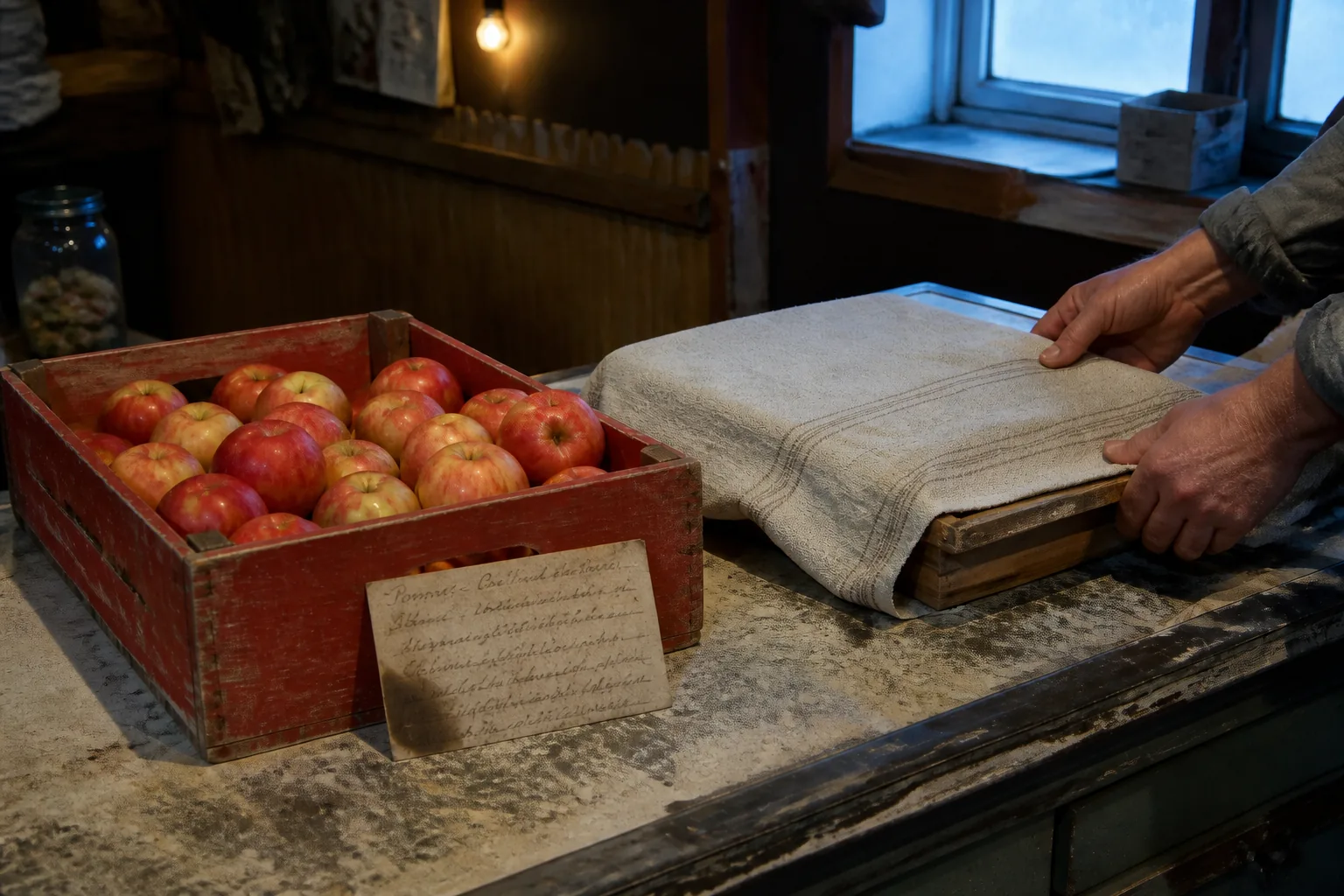
There is a sign at the market that does an impressive amount of work for a few letters.
IN SEASON.
It can make one pile of fruit look considerably more virtuous than the rest of the table.
Sometimes it should.
But the sign is answering a different question from the one you meant to ask.
Seasonal describes availability. Fresh describes condition.
They often travel together, which is why the confusion is so reasonable.
A crop coming in locally has probably had less time to be held and moved and made presentable.
It may be abundant. It may be exactly what you wanted to cook this week.
That is a real advantage.
It’s not a warranty card.
An apple can be local and tired. A transported one can arrive with more life left in it.
A peach can be perfectly in season and have had a difficult morning. Fruit is under no obligation to live up to the marketing copy.
Seasonality is a map of supply
Seasonality is biological availability, plus location, plus storage, plus trade.
That last pair matters more than the sign admits.
A crop can be growing nearby, or sitting in storage, or brought in from somewhere whose season runs opposite to yours.
The word does not travel intact across regions, and it stops explaining much once the harvest leaves the field.
Even for direct-market produce, the path runs through picking, cooling, sorting, packing and transport before you start choosing fennel with the gravity of a minor election.
Food may move straight from a farm to a stall. It may also pass through a shared aggregation point or a distributor.
Those are different routes, and they do not leave the same amount of remaining life, even when the price cards use the same cheerful adjective.
Seasonality also explains why a market looks different week to week. Abundance lowers a price.
An early or late crop is scarce. Weather, pests, labor, fuel and local demand rearrange a market fast.
So do packing, stall setup, refrigeration and the risk of unsold food going home again.
A market price is not an argument for or against the food. It is a crowded little receipt.
A local crop can still cost more than the commodity alternative, and that’s not a failure of the crop or the seller or your arithmetic.
It is what happens when supply and the cost of getting supply to a stall decline to be the same thing.
Local is a provenance claim
“Local” can be genuinely useful.
It may mean a nearby producer, a short supply relationship, a market that keeps regional varieties visible.
It does not automatically mean a lower price, fewer emissions, better labor conditions, or better condition in your hand.
The more specific claim is almost always the more helpful one. Grown on this farm. Made in this kitchen.
Bought through this co-op.
Specific words are not less romantic.
They are only less willing to make promises on behalf of a tomato they have never met. The same goes for the other words on the sign.
“Fresh” is sometimes a legal term rather than a description: on raw poultry it refers to a temperature history, not to how the bird looks or when it was packed.
A label answering a regulatory question can sit right beside a label answering a sensory one, in the same font, on the same card.
Variety belongs here too, and it is not decorative detail. “Apple” is enough if the plan is to eat an apple.
It’s not enough if the question is how that apple will behave in a tart, because the cultivar is doing most of the work in that sentence.
A name tells you what family you are standing in. The properties tell you what it can actually do.
Freshness is what remains after the route
Freshness is not a single event.
It is the condition left over after harvest, cooling, sorting, packing, transport, display and holding. Which is why the short question beats the grand one.
Ask what variety it is.
Ask when it was harvested or delivered.
Then look at the thing.
Firmness and aroma aren’t the whole record, but they are current information, and the sign cannot give you any.
Ask when the stall is quiet.
A vendor can answer a specific question far more honestly than a broad one, and nobody needs a full farm audit while a line forms behind them for radishes.
Ethylene is the reason the present tense matters so much.
Ethylene-producing fruit hastens the ripening of ethylene-sensitive produce stored near it, at the market and again in your kitchen.
That is not a small etiquette rule for the crisper drawer.
It means two items can be equally seasonal and have very different remaining lives, because of what they were stored beside.
The seasonal sign was not lying to you.
It was answering for the crop rather than for this particular plum.
Storage names a control, not a history
“Kept refrigerated” can be entirely true and still insufficient.
A storage temperature names one control.
It does not describe what happened before the cold started, and it cannot undo any of it.
Light, odor transfer, packaging and handling all belong in the same record, and none of them appear on a card either.
The same distinction follows you home. Carry delicate produce carefully. Keep raw animal food away from what you will eat uncooked. Refrigerate perishables promptly.
And buy the quantity that fits your actual week, your transport, and your refrigerator, rather than the optimism briefly induced by a beautiful pile of beans.
Freshness has a household half as well as a market half, and the household half is entirely yours.
Where the two questions meet
A good market purchase starts with seasonality, because availability genuinely matters. It continues with provenance, because “local” needs a real claim behind it.
It ends with condition, because the ingredient still has to perform on a Thursday.
Ask for the variety. Ask when it came in. Feel it. Smell it. Buy what you can use.
None of that will make every seasonal peach perfect.
It will stop you buying a bruised local one on principle, while walking past something that would have been better in the pie.