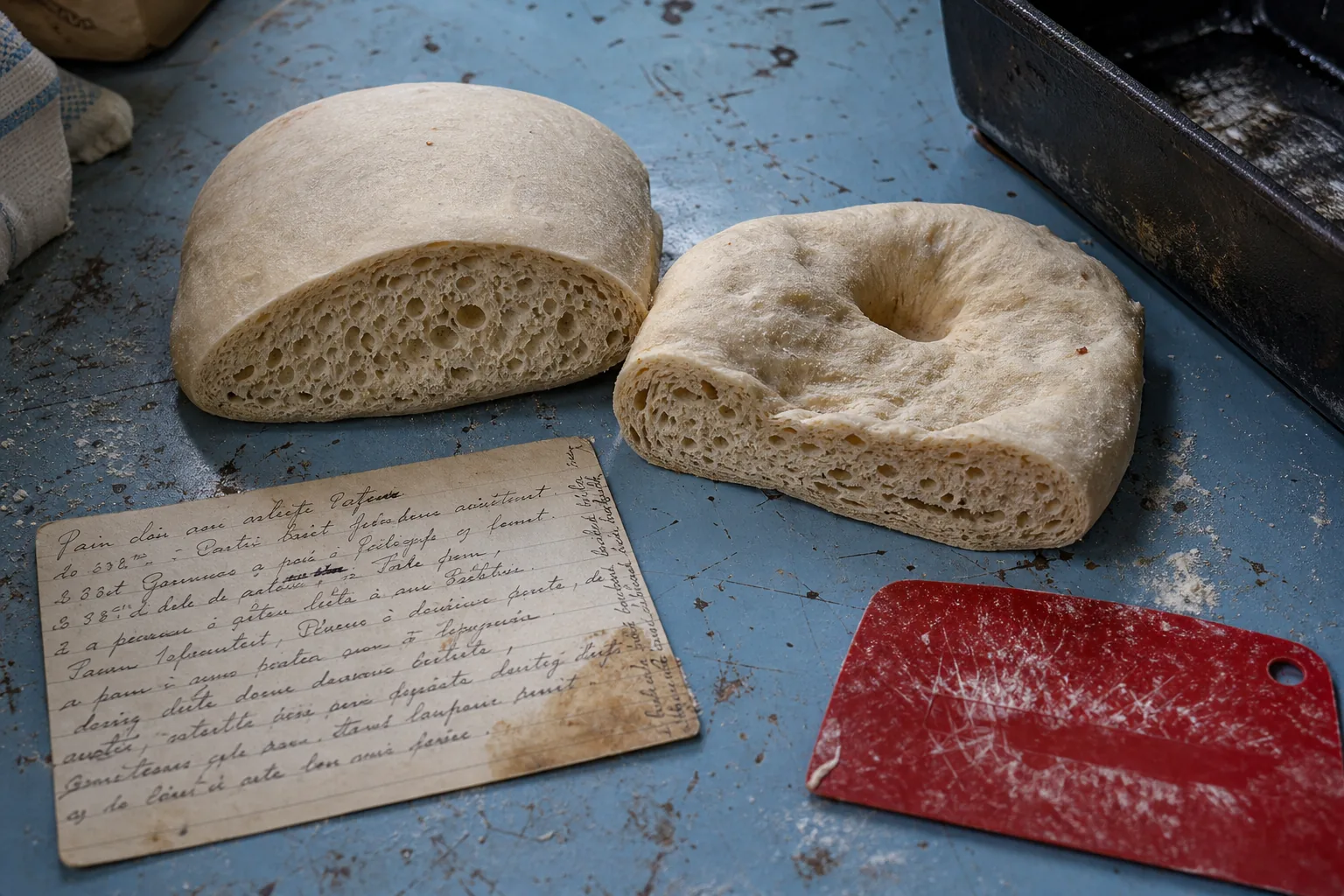
There is a particular disappointment that arrives when the oven door opens.
The dough had looked magnificent.
High. Bubbled. Soft enough to make you feel briefly competent.
Then it spreads sideways, opens weakly at the score, and gives the impression that the whole loaf has had a discouraging afternoon.
The usual diagnosis is that it needed more time.
It may have needed less.
A dough that has made plenty of gas is not necessarily a dough that can still hold it.
That is the small betrayal inside proofing. Fermentation and readiness overlap, and they’re not the same instruction.
Yeast is alive. Given water and something to eat, it ferments, and that activity makes gas and flavor.
Gluten development is a separate matter. It decides whether the dough can keep the gas once it has it.
Then shaping supplies surface tension, and a pan or a basket supplies support.
The loaf needs all of those to agree during the brief useful violence of oven spring.
When they stop agreeing, more proofing is not optimism. It is administrative delay.
Fermentation is not a timer
Hydration is water relative to flour by mass. It is not an atmosphere or a personality trait.
A firm dough often needs less folding. A wetter, slacker one demands different handling entirely.
Neither number tells the whole story, because white flour, whole wheat, rye and gluten-free blends do not absorb water or build structure the same way.
The clock doesn’t get a vote on its own either. How much yeast or starter went in changes the pace. More shortens the schedule.
Less permits a longer one, which is the whole reason anyone keeps a starter.
Final dough temperature is the other clock, and it is the one people forget. A cool dough moves slowly.
A warm dough reaches readiness fast and then keeps going, which is the actual difficulty. Salt, sugar, fat, acid and whole grain move the pace again.
A lean hearth loaf, an enriched sandwich loaf and a rye sourdough are not three opinions about one schedule.
They are three different systems wearing aprons.
Proof asks whether there is anything left
Bulk fermentation asks the dough to develop gas and flavor while your folds build strength.
Final proof asks something narrower.
After shaping and a bit more fermentation, can this dough still expand in the oven without losing its shape?
The answer lives in volume, bubbles, elasticity and surface tension together.
Not in one heroic bubble.
The finger test is useful because it makes the question physical. Press lightly. A dent that springs back quickly says there’s time left.
One that stays deep and slack says most of the reserve has already gone into becoming very puffy.
Read that beside the dough’s volume and temperature, though. High-hydration doughs, cold doughs and enriched doughs all recover differently.
The press is a clue, not a tiny tribunal.
The point isn’t to demand a perfect gesture from your fingertip. It is to stop treating puffiness as a one-way measure of success.
An under-proofed loaf bursts unpredictably and keeps a tight crumb. An over-proofed one spreads, collapses, or springs weakly.
Both disappointments are about expansion. Their remedies are opposite.
Which is how a loaf can look late and actually be finished.
Strength is built before it is spent
Mixing intensity, rest duration, the number of folds and their spacing all control gluten development.
If a dough tears during a fold, rest it.
If it spreads immediately, it may want a fold, or less handling, or more support.
What it does not want is a great deal of extra flour thrown at it to win the argument.
That changes hydration, and a dense loaf is a fairly stern reply.
Folds are not a moral exercise.
A slack relaxed dough may need a stretch and fold. A strong dough should be left alone rather than worked and degassed on principle.
For a fine-crumb sandwich loaf, firmer degassing suits the form you want.
For an open crumb, you are trying to keep the larger gas cells you already made.
Then comes shape.
Pre-shaping organizes the dough. The bench rest lets it relax. Final shaping creates the tension that helps it stand up.
A pan gives lateral support. A basket holds a wet loaf until it goes in.
A free-form loaf has to hold itself together with nothing but the tension on its own surface.
None of that makes fermentation optional. It gives fermentation somewhere to live.
Oven spring is a test, not a rescue
Scoring directs where a hearth loaf opens. Steam or a cover delays the crust setting.
Higher heat encourages early spring and color.
All genuinely useful.
None of it repairs a dough whose structure already weakened during final proof.
That is why an over-proofed scored loaf spreads sideways and bakes pale at the seams.
The score was asked to organize an expansion the dough could no longer contain.
You are allowed to call the result rustic. Calling it a proofing lesson is more useful.
Preheat matters for the same unromantic reason.
If the oven is not ready when the dough is ready, the dough waits. And a ready dough does not get readier while waiting.
Once it is baked, cool it on a rack so the steam can leave and the crumb can set before you cut it.
Bread that needs to last is usually better frozen after cooling than refrigerated.
Keep a record, not a stopwatch
Mark the starting level in your bulk container.
A straight-sided clear tub turns “it looks bigger” into something you can actually see.
Write down the flour, the hydration, how much starter or yeast went in, and the final dough temperature.
At final proof, look at the volume and the surface tension. Then use the light press.
Afterward, note what support you used, how you scored it, whether you steamed it, and how the loaf actually opened.
Four or five loaves of that and the mystery mostly evaporates.
Not because you learned a rule, but because you learned this flour, this kitchen, and how warm your counter really is at four in the afternoon.
The dough was never late.
It was somewhere in its own schedule, and the only way to find out where is to keep looking at it rather than at the clock.