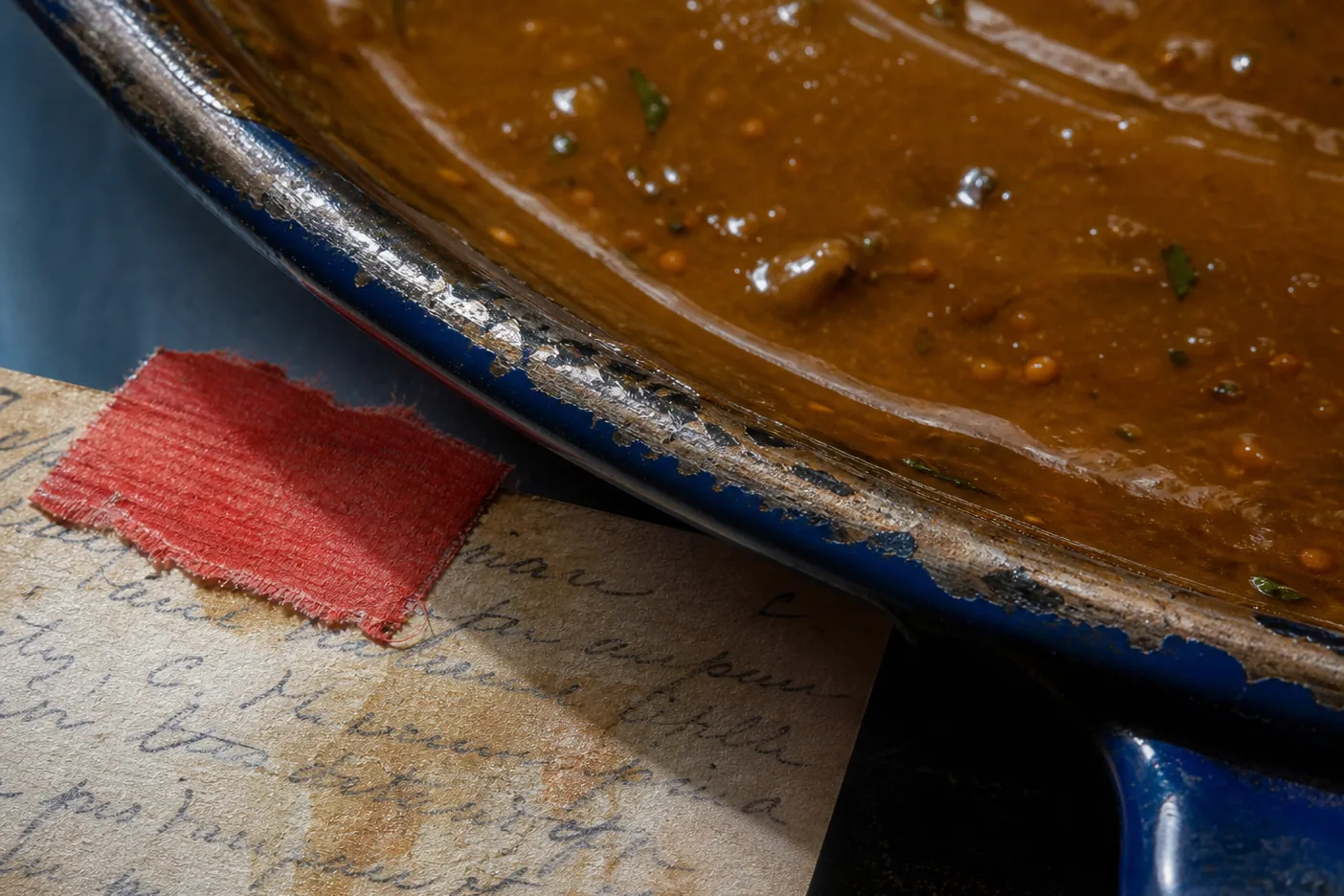
Everyone knows the flat sauce problem by now.
It has enough butter. The stock was good. You salted as you went. It still tastes muffled, and the answer is usually acid rather than more salt.
Fine. Take that as read.
Here is the part that comes after, and it’s the part that ruins more dinners.
You have decided the sauce needs something.
Now you have to work out when, and against what, and the pot has opinions about both.
Salt increases intensity; acid restores contrast. Aroma is a third thing entirely, and it keeps a different clock.
Those three do not arrive at the same moment, they do not survive the same amount of heat, and a sauce tasted alone will lie to you about all of them.
The pot is concentrating while you deliberate
Reduction is the reason seasoning early is a gamble.
Water leaves. Salt does not.
Neither does the salt in the stock, the soy, the cheese, the cured meat, or the perfectly innocent commercial condiment you added forty minutes ago.
So a sauce that seemed merely subdued at the halfway mark can arrive at the end as a very expensive salt lick.
This is not a flaw in reduction. It’s reduction working.
But it means your seasoning decision has a moving target underneath it, and the target moves in one direction only.
Season lightly while the volume is still changing. Make the real decision when the volume has stopped.
A starch-thickened sauce behaves differently, which is worth knowing before you pick your thickener.
A roux gravy or a slurry gains body from hydrated starch, so it can become substantial without concentrating anything.
Reduction gives you intensity. Starch gives you body.
If you reach for reduction when what the dish wanted was body, you will end up salty and still not coating anything.
Aroma leaves on its own schedule
This is the axis the salt-and-acid conversation usually skips, and it explains a whole category of sauces that taste correct and somehow dead.
Toasting whole spices deepens their aroma.
Blooming ground spices briefly in warm fat spreads their fat-soluble compounds through the dish.
Both work. Both build depth.
Neither one gives you a high note, and after twenty minutes of simmering, neither one is going to.
Ground spices burn fast in hot fat, and burnt spice is bitterness wearing a name tag.
Whole spices suit a long infusion.
Ground ones disperse immediately and can go gritty if there is not enough moisture to take them.
Meanwhile the delicate things are evaporating.
Basil, cilantro, dill, mint, parsley, chives, citrus zest, good oils: all of them lose most of their character to a long simmer.
Which is why an early bay leaf and a late handful of parsley are not redundancy. They are two different clocks, and a sauce needs both hands.
If your sauce has depth and no lift, the missing thing may not be acid at all.
It may be something raw, added in the last thirty seconds, that still remembers being a plant.
Taste it against the food
A sauce by itself is a tiny private jurisdiction.
Nothing is drawing moisture out of it. No crust is softening under it.
No roast is contributing its own salt and fat. No potato is sitting there absorbing the whole argument.
So the spoon will tell you something true about the sauce and nothing reliable about dinner.
Dip the thing it is meant for.
A piece of the meat, a strand of the pasta, a spoonful of the beans.
Then taste it at the temperature it will actually be served at, because that changes it too.
A gravy that was right at the stove sits heavier on a warm plate. An emulsion that was glossy in the pan can tighten on the way there.
A gravy that was perfect at the stove can be heavy on a warm plate.
You will find that a sauce which tasted slightly under-seasoned alone is often exactly right on food, and a sauce that tasted perfect alone is frequently too much.
That is not a failure of your palate. It’s arithmetic.
The food is going to dilute the sauce, and the sauce was never meant to be eaten by the spoonful in a quiet moment of self-assessment.
Reserve, don’t commit
The practical habit is small and slightly undignified.
When you are unsure, do not season the pot. Take out two spoonfuls and work on those.
Salt into one. A drop of something sharp into the other. Taste both against the food.
If neither is the answer, take a third and try aroma: a scrap of torn herb, a scrape of zest, a drop of good oil.
That third spoon is the one people skip, and it is the one that solves the sauces nobody can diagnose.
The cost of being wrong on a spoonful is a spoonful.
The cost of being wrong in the pot is dinner, and possibly a small speech about how it is fine, actually.
The failure modes are distinguishable
Each of the three has a recognizable way of going wrong, and once you know them you can work backward.
When food genuinely needs salt, salt improves it cleanly for several rounds. Each addition brings more into focus, until you reach the edge and know it.
When food needs acid, salt gives up almost immediately. The first pinch helps a little. The second does nothing.
The third makes you thirsty.
When food needs aroma, both salt and acid make it louder without making it more interesting.
The sauce gets sharper, or saltier, and stays exactly as flat as it was.
That last pattern is the useful one to recognize, because it is the point where most people keep alternating between the salt and the vinegar, getting a more aggressive version of the same problem each time.
Stop there. Go and tear something green.
Rich food needs a hard surface somewhere in the room, and acid is often it. But a room can have hard surfaces and still smell of nothing.